The phrase can describe a machine area, but it does not establish a venue’s identity, location, operator or facilities.
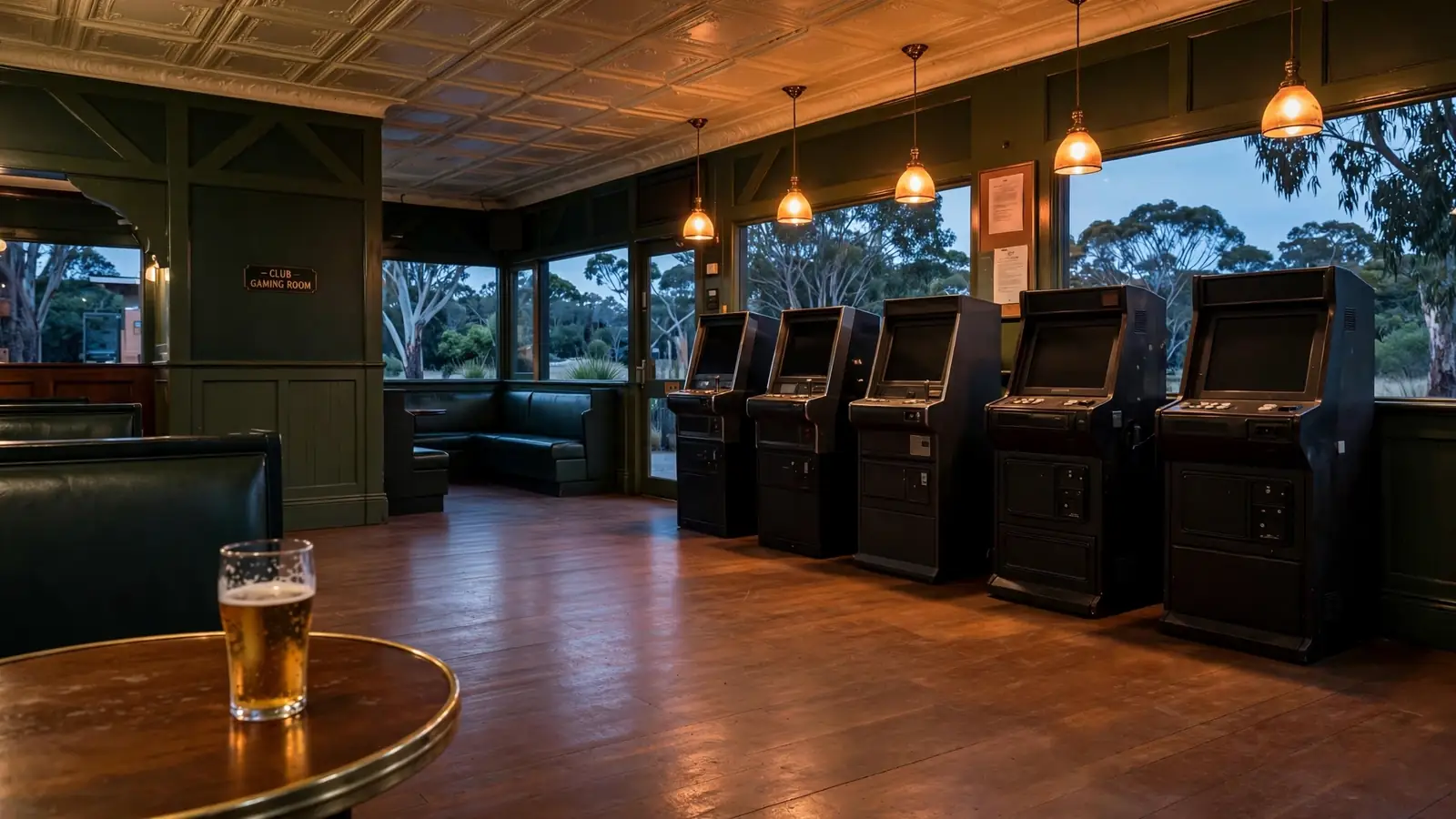
In Australia, “pokies” is a familiar informal term for gaming machines. A parlour, in everyday use, suggests a room or area where machines are available. Put together, the words can point to a casino gaming floor or to a more general idea of a place associated with these machines. They do not, by themselves, identify a particular venue, business or online service.
That distinction matters. A phrase such as “pokies parlour casino” may sound like a proper name, but it is not proof that an establishment with that name exists. Nor does it establish where a venue is, who operates it or what facilities it has. Those details need to be tied to a verifiable property, rather than inferred from a label.
Australian casinos are physical properties operating under licences issued by their state or territory. The phrase “pokies parlour” is not a substitute for that property information. It may be used informally to describe a machine area, but it does not tell you whether the place being described is a full-scale casino, another kind of gaming venue or simply a concept in promotional wording.
If you’re looking for a pokies-style casino to consider in Australia in 2026, this list gives you a concise reference point based on the available details for each operator. Use the stated licence, deposit and payout information to assess what matters to you.
Playfina Casino
Playfina Casino is listed with a Curacao eGaming licence held by Hollycorn N.V. since 2017. You’ll need to check the offer, as the stated minimum deposit varies from A$20 to A$30.
House of Pokies
House of Pokies lists an international iGaming licence, though the source does not name the jurisdiction. If you use PayID, the stated payout time is 1–24 hours; the minimum deposit is A$30, or A$10 with PayID.
Wild Tokyo
Wild Tokyo is listed with a Curacao licence and a A$10 minimum deposit. Its stated payout times are 30–60 minutes for crypto and 1–5 days for fiat.
DragonSlots Casino
DragonSlots Casino is listed with a Curacao Gaming Authority licence, with Jumpman Gaming Ltd named as the operator.
Kingmaker
Kingmaker lists a A$30 minimum deposit. Its stated payout times are around 90 minutes for crypto and 1–5 days for fiat.
7Bit Casino
7Bit Casino is listed with a Curacao licence and is operated by Dama N.V.
MrPacho
MrPacho lists a A$30 minimum deposit. Its stated payout times are 30–120 minutes for crypto and 24–72 hours for fiat.
Vegaz Casino
Vegaz Casino is listed with Curacao licence OGL/2024/1335/0780. The stated minimum deposit is EUR 20.
LevelUp Casino
LevelUp Casino is listed with Curacao eGaming licence OGL/2023/174/0082, with Dama N.V. named as the operator. Its stated minimum deposit is A$15.
Rollero Casino
Rollero Casino is listed with Curacao Gaming Control Board licence OGL/2023/176/0095, held by Hollycorn N.V.
A useful comparison is between a venue name and a category. A named casino can be checked against its location and operating identity. A broad phrase such as “parlour casino” has no comparable precision on its own. Two writers might use it to mean different things: one could be referring to a casino’s gaming floor, while another might be using it loosely for a venue offering gaming machines. The wording alone cannot settle that difference.
This is also why a page or advertisement using the phrase should not be treated as a venue listing. A trustworthy description should make clear which physical property it concerns. If it does not, the phrase remains a general description, not a confirmed address or an independently established business.
The practical test is simple: separate the label from the evidence. A label can suggest the subject; a specific venue record supplies the identity. That is a small distinction with a large effect on what you can reasonably conclude.
Australia’s casino industry is regulated by state and territory governments, and each casino operates under a licence issued in its jurisdiction. The gaming-machine area is therefore part of a broader licensed property, not a stand-alone meaning attached to the words “pokies parlour.” The term does not tell you the licensing arrangement or the boundaries of a particular venue.
 Best Pokies in Melbourne: What to Check Before You GoLearn how to verify venue addresses, pokies availability and opening-hour claims across Melbourne, including near the airport and in the CBD.
 Big Red Pokies Online in Australia: Free Play GuideLearn what can be verified about free play, Australian availability and game access, and why labels alone do not confirm the terms.
A specialist review has described Australia as having more than 20 full-scale casinos across all eight states. That figure should be read as an attributed snapshot rather than a fixed definition of the market: venue counts can change, and the wording of a review does not establish the identity of every place described informally as a parlour.
There is also a national machine-count measure that gives a different kind of context. The recorded total is 3,308 gaming machines endorsed on venue licences and installed in Australian casinos. This is a count tied to licensed venues, not a count of every machine in every type of gaming location. It should not be stretched into a claim about the selection at an individual property or the meaning of a casual label.
The distinction between a casino and a machine room is worth keeping in view. A casino is a licensed property; a gaming area is one part of its operation. Calling that area a parlour may help someone describe it informally, but it does not turn the area into a separately verified venue. Nor does a national count tell you what a specific casino offers.
If you encounter “pokies parlour casino Australia 2026” or a similar phrase, read it as a broad description of a topic, not as a verified name. The same caution applies to variations such as “pokie parlour” and “parlour casino”: spelling and word order can shift, while the underlying uncertainty stays the same.
Attention: A phrase like "pokies parlour casino" is a general description and not proof of a specific verified venue or business address.
For a physical venue, the useful identifiers are its recognised name, location and responsible operator. For a general discussion, the phrase can be understood as referring to casino gaming-machine areas, provided it is not presented as a formal category with a universal definition. The label is a starting point, not a credential.
That keeps the comparison honest. A search label may be broad; an identified property can be checked against concrete details. When those are treated as interchangeable, the wording appears more specific than it really is. Labels are not addresses.
A sign-up bonus or no-deposit offer may sound like a simple invitation to open an account. For an Australian audience, that framing leaves out the main issue: real-money online casino games are not a lawful service for operators to provide to people in Australia. A promotion cannot make the underlying service permissible.
The Interactive Gambling Act 2001 prohibits operators from supplying online casino-style gambling to customers located in Australia. That category includes games such as slots, poker and table games. So an online casino welcome offer is not comparable to an ordinary retail discount, and the phrase “no deposit” does not change the legal character of the service being promoted.
“Sign-up bonus” describes a marketing claim, not a legal category that grants an exception. “No-deposit bonus” similarly suggests that a person can begin without making an initial payment; it does not establish that the offer is available to Australians or that the service behind it may lawfully be provided here. The label alone tells you nothing reliable about eligibility.
That distinction matters because promotions can draw attention away from the more basic question of whether the activity itself is allowed. A prominent offer, polished terms page or account-registration process does not turn prohibited online casino gambling into an authorised service. Nor does a claim that an offer is intended for new customers settle whether Australians may receive it.
The same reasoning applies to searches for a “pokies parlour” sign-up bonus. The wording can blur a physical gaming venue and an online service, although they are not interchangeable. Australian casinos are licensed within their respective state or territory jurisdictions. That local venue framework should not be read as permission for an online casino to offer real-money games to someone in Australia.
The rules concern more than the games themselves. Advertising real-money online casino services to Australian audiences is also prohibited. A bonus promoted as a welcome reward, a free-entry incentive or a reason to register remains advertising for the underlying online service; changing the promotional language does not remove that connection.
Inducements and promotions are subject to restrictions, and gambling advertising rules require particular care during the period from 5:00 am to 8:30 pm. For online casinos, however, the central point is not to look for a clever time slot or a different label: advertising such services to Australians is not permitted. A disclaimer or small-print condition does not convert a prohibited promotion into an ordinary offer.
Legal Prohibition
The Interactive Gambling Act 2001 prohibits operators from supplying real-money online casino-style gambling to customers located in Australia.
This is why the question is not simply whether a person meets an operator’s stated sign-up conditions. A website might describe who it hopes to attract, but those conditions do not override Australian law. The relevant distinction is between a marketing claim and an offer that can lawfully be made to people here. Those are not the same thing.
The minimum age for entry to a casino in Australia is 18. That nationwide age threshold is relevant to physical casino entry, but it should not be mistaken for permission to take up an online casino bonus. Being old enough to enter a venue does not make online real-money casino games lawful for operators to provide in Australia.
If a promotion combines references to a parlour, casino games and account registration, separate the claims before drawing a conclusion. The venue wording may refer to a physical place; the account and bonus language may relate to online activity. One cannot be used as proof of the other. Read the claim according to what it actually describes.
A useful comparison is to treat the label, the stated audience and the underlying activity as separate columns. The label tells you how the promotion is presented. The audience wording tells you whom it claims to target. The activity identifies what the operator is asking people to do. In Australia, that last column matters most when the offer concerns real-money online casino games.
No-deposit wording can make an offer sound lower-risk or easier to access. It does not change the law, confirm Australian eligibility or establish that the advertised service is permitted. The offer’s name is the least decisive part.
A website loading on your phone tells you that the address can be reached. It does not show that the service is authorised to offer online casino games to people in Australia. The same applies if an account page opens, accepts account traffic or appears under a different web address. Technical access and legal status are separate questions.
That distinction matters because Australian law prohibits operators from supplying real-money online casino-style games to people in Australia. The Interactive Gambling Act 2001 covers services involving games such as poker, blackjack, roulette and slots. A site’s claims about its location, software or overseas credentials do not change that rule for services provided to Australian customers.
So if you are trying to work out whether an online version of a pokies parlour is legitimate, do not treat a working website as evidence of Australian authorisation. There is no Australian licence for an operator to provide prohibited real-money online casino services to people here. A polished account area is still just a polished account area.
The Australian Communications and Media Authority (ACMA) is the federal agency responsible for enforcing the Interactive Gambling Act and monitoring compliance with federal interactive gambling rules. Where a website provides prohibited gambling services, or advertises them in Australia, ACMA can ask Australian internet service providers to block access.
ACMA can request that Australian internet service providers block access to websites that provide prohibited gambling services or advertise them in Australia.
Blocking is an enforcement measure, not a general certification system. A site that remains reachable has not thereby passed a legal check. Nor does a blocked address prove that every related address is blocked: web addresses can change, and an alternate domain may appear. The important point is that the route used to reach a service does not determine whether its underlying offer is lawful.
ACMA reports that enforcement actions have led to more than 1,455 illegal gambling and affiliate websites being blocked since November 2019. Those actions also form part of a wider effort to stop prohibited services from operating in Australia. A separate reported measure says more than 210 illegal services have withdrawn from the Australian market since enforcement began in 2017. Another published figure puts withdrawals at over 190. The reported totals differ; neither makes a particular website legitimate.
When you encounter a site presenting itself as an online casino, separate observable details from legal conclusions:
| What you can observe | What it establishes |
|---|---|
| The homepage loads | The address is reachable at that moment |
| An account page accepts traffic | The site is processing that activity |
| A new or alternate domain works | That address currently resolves |
| The site describes itself as licensed | The operator is making a claim |
None of those observations establishes that the service may lawfully provide real-money casino games to people in Australia. The relevant test is not whether you can open the page, sign in or see account activity; it is whether the service is permitted under Australian law. For online casino-style games, the law prohibits operators from offering them to customers located here.
If you need to check the regulator’s role or enforcement information, ACMA publishes material through its official website. That is more useful than treating an accessible page—or a replacement address—as proof of legitimacy. Access is a technical fact, not a legal status.
Words such as “free chips”, “free spins” and “free play” can sound like a clear offer. On their own, though, they are only promotional labels. They do not confirm that a particular Australian venue or service exists, that an offer is available, or that anyone can claim it.
The distinction matters because a phrase attached to a parlour or casino may describe a promotion, repeat wording from another page, or simply be part of a headline. It is not proof of who is making the claim. Nor does the label tell you what the offer covers, who may qualify, or what conditions apply. Those details need to be stated clearly and tied to an identifiable provider before the wording can be assessed as an actual offer.
A useful first check is to separate the promise from the evidence. Look for the name of the venue or service responsible, a clear explanation of what is being offered and terms that match the headline. If the page gives only a bold “free” message, the important information has not been established.
Be precise about what the language refers to. A physical venue, an online page and a promotional description are not interchangeable. A page using casino-style wording does not, by that wording alone, establish a connection to a particular venue. Likewise, a mention of free play does not verify that a visitor will receive anything.
This is not a reason to treat a more detailed headline as reliable by default. Specific language can still be unsupported. The better test is whether the claim identifies its source and explains its conditions in a way that can be checked, rather than asking you to infer those details from the word “free”. A label is not a receipt.
Australian internet service providers may be affected by website-blocking measures, which can change which domain addresses resolve. Alternate addresses may also appear over time, as a specialist review has reported. That describes changes in access, not the status of the service behind an address.
If one address stops loading and another appears, the change does not confirm that the new address belongs to the same operator, that an offer remains valid, or that the service is authorised to provide what it advertises. The same caution applies if a page loads normally: accessibility is not proof of legitimacy. An address that works is simply an address that works.
 Pokies in Canberra: How to Check Venues and HoursLearn how to verify gaming-room hours, distinguish venue listings from room access, and assess location and online-pokies claims.
 Best Casino in Melbourne: Hotel and Visit GuideCompare casino hotel rates, room terms and costs, and check practical details for a Melbourne visit, from parking to venue information.
That distinction is especially useful when a promotional page leans on familiar casino language but gives little verifiable detail. Treat the wording, the identity of the provider and the terms as separate things to assess. A claim may sound generous while leaving the central questions unanswered.
For a physical venue, look for details that identify the actual place and its operation; for an online promotion, do not mistake a changing web address for those details. The words “free chips” or “free spins” cannot bridge that gap. They may tell you what a page wants you to notice, but they cannot, by themselves, establish a venue, a valid offer or its conditions.
A useful review gives you details you can check against the venue itself. A string of praise tells you little; a named property, a clear location and a specific description of what was assessed give you something to compare. Treat the review as a set of claims, not a verdict you have to accept.
Check that the review identifies a particular physical venue rather than using “parlour” as a loose label. The name should match the property’s own materials, and any address should be precise enough to distinguish it from other locations or similarly named businesses. If the review shifts between a casino, a hotel and a gaming room without explaining which one it means, its comparisons may not be like for like.
Then look at when the review was written or updated. Venue details can change, so a claim with no date is harder to weigh than one tied to a clear point in time. A recent date does not make a statement true; it simply helps you judge whether it is worth checking.
Operating hours are a practical test because vague wording can conceal an important difference. All major Australian casinos operate around the clock. If a review describes a major casino as having limited daily hours, check that claim against the venue’s current published information before relying on it. The mismatch may reflect an outdated review, a special area within the property, or a different kind of venue. Those are not interchangeable explanations.
Be precise about what the hours refer to. A review may discuss the casino, a restaurant, a hotel service or another part of a larger property. “Open all day” is not a useful description if the writer has not identified which facility is meant. Likewise, a mention of a temporary closure should be tied to the specific service and date, not presented as the normal schedule.
Look for concrete observations and ask whether they support the review’s overall assessment. A reviewer who explains what was checked gives you a firmer basis for comparison than one who relies on labels such as “excellent” or “premium.” Promotional language can sound decisive while avoiding any measurable criterion. Neat phrasing is not evidence.
A sensible reading also distinguishes a factual statement from an opinion. “The venue operates around the clock” is a checkable claim; “the atmosphere is unmatched” is a preference. The latter may matter to you, but it cannot establish the former. Decide which criterion matters for your visit, then compare reviews on that criterion rather than treating one overall score as universal.
Before accepting a review’s conclusion, check whether it supplies:
If these details are missing, the review may still express someone’s opinion, but it is a weak guide to planning. A review that separates verifiable details from personal preference is more useful than one that bundles them into a confident rating. The better review depends on your criterion: for planning a visit, clear venue and hours information beats glowing generalities.
Australia’s gambling facilities are spread across cities in every part of the country, but a national count is only useful when you know what is being counted. A city tally can describe the reach of gambling venues; it does not, by itself, tell you how many venues are concentrated in each neighbourhood, how large they are, or whether they are casinos rather than other kinds of gaming venues.
One specialist gambling-venue review reports facilities across 147 Australian cities. Treat that as the review’s mapped snapshot, not as a permanent official total: venue lists can change, and counting rules can differ. The figure is still a useful indication of geographic spread. It suggests that gambling facilities are not confined to a handful of well-known metropolitan centres. But the count should not be read as 147 cities with the same mix of venues or the same scale of provision.
Facilities are reported across 147 Australian cities, indicating a broad geographic spread.
Identified as Australia's largest gambling city with a count of 11 gambling facilities.
Venue counts and rankings are snapshots from specialist reviews and can change over time.
Sydney stands out in that review’s comparison. It identifies Sydney, in New South Wales, as Australia’s largest gambling city and counts 11 gambling facilities there. Those two details belong together: “largest” is the review’s ranking, while the facility count is its measure. Neither says that every facility is a casino, that all are clustered in one district, or that the count is an up-to-date government register. A ranking without its counting method can look more definitive than it is.
For you, the useful comparison is therefore not simply “Sydney versus everywhere else.” Ask what a geographic claim measures. A city-level total answers a different question from a list of casino properties, a count of licensed premises, or a map of gaming venues. If the source does not explain its category, a precise number can still leave the central point unclear.
The difference matters especially when a page uses “parlour” broadly. That label may suggest a local gaming room, a casino floor, or simply a general gambling destination, but it does not define a recognised national category on its own. The location count should not be taken as evidence that every listed facility offers the same type of gambling or has the same operating arrangements.
A sensible way to read Australia’s footprint is in two layers: the broad distribution across cities, then the individual venue’s identity and location. The 147-city figure gives a sense of reach; Sydney’s reported 11 facilities show how one specialist review ranks a major centre within that map. Neither figure substitutes for checking what a particular place actually is.
 Best Pokies in Perth: What to Check Before You GoLearn how to confirm that a Perth venue and its pokies are both operating, and compare venues using official hours and direct…
 Pokies in Brisbane: Venue Hours and What to CheckLearn why venue opening times may not confirm pokies access, and how to check gaming-room hours directly before planning a visit.
That distinction also keeps a national overview from turning into a misleading directory. A city may appear on a broad gambling map without having the same number or kind of facilities as Sydney. Conversely, Sydney’s position in one review does not make its count a settled benchmark for every future comparison. The geography is informative; the labels and counting rules still matter.
A bonus label tells you how a promotion is being presented, not who is behind it or whether its conditions are clear. “Parlour” can suggest a physical gaming venue, while “bonus” can suggest an online offer. Put together, the words still do not verify a particular venue, service or promotion.
Treat each claim as a set of separate checks. First, identify the entity making it: is it a named venue, an online service, or a page referring you elsewhere? Then look for terms tied to that same entity. A headline, banner or short description is not a substitute for conditions explaining who qualifies, what the offer covers and what restrictions apply. If the details are absent, difficult to connect to the advertised service, or change across pages, the label cannot fill the gap.
Comparing Bonus Claims
Identify the Entity
Determine if the claim comes from a named venue, an online service, or a third-party page.
Verify the Terms
Locate the specific conditions explaining who qualifies, what is covered, and what restrictions apply.
Cross-Reference Source
Ensure that the provider and the conditions are tied to the same entity across all pages.
This is a comparison problem, not a vocabulary test. One claim may be more specific than another because it names the provider and sets out its conditions in one place. That makes the claim easier to assess; it does not, by itself, establish that the service is lawful or that the offer is available to you. Keep those criteria separate.
ACMA’s enforcement activity is relevant context. The regulator has taken website-blocking action against illegal gambling services, including alternate domains associated with Fair Go. Its record also includes action involving affiliate websites. That matters because a page describing an offer may not be the service providing it, and promotional wording can travel across sites. A bonus label is not a regulatory finding.
Nor should a changing address or a polished presentation be treated as confirmation. Enforcement can affect which domains are reachable, and alternate addresses may appear. The useful question is not whether a page looks current, but whether its claims can be tied to a clearly identified source and coherent terms. A convincing design is easy to produce. Evidence is harder.
When comparing bonus claims, write down the provider, the exact offer conditions, and the source of each detail. Mark anything that cannot be matched to the same service as unverified, rather than filling the gap with an assumption. If the wording promises a benefit but does not let you establish its conditions, it has not earned a place in the comparison.
 Geelong Pokies: Checking Hours and Gaming AccessLearn how to verify gaming-room access, interpret venue listings and assess claims about opening hours, payments and “best paying” pokies.
 Best Pokies in Tasmania: Hours and Venue GuideA venue’s general opening status does not confirm its pokies are operating. Check its published gaming hours or contact the venue directly.
The label is the easy part.
“VIP” sounds specific, but on its own it does not identify a particular membership scheme, explain how anyone qualifies, or confirm that a venue has a separate public-access arrangement. It is a label, not a set of entry terms. The word “parlour” does not fill in those gaps.
For you, the useful distinction is between a description and a condition. A description may suggest a more exclusive experience; a condition would state who can enter and what is required. Without venue-specific terms, you cannot infer member benefits, priority access, a private room, or permission for non-members to enter. Those details would need to be confirmed by the venue itself.
The firm baseline is clearer: casino entry in Australia is limited to people aged 18 or over. Major casinos also require valid photo identification for entry. That age requirement does not, by itself, establish whether a particular area is open to the public, members-only, or subject to additional venue rules. Nor does the VIP label override the entry-age baseline.
When comparing descriptions, use the same test for each: does the venue provide a clear, verifiable explanation of its entry arrangements, or does it rely on the word “VIP” to do the work? The first gives you something concrete to assess. The second leaves the key question unanswered. Glossy wording is easy.
Casino entry in Australia is limited to people aged 18 or over, and major casinos typically require valid photo identification for entry.
Do not treat “VIP” as proof that a named parlour exists or that a specific membership programme is available. It may be used loosely, and the phrase alone cannot tell you what happens at the door. Age is the nationwide starting point; any further access detail must come from reliable information about the particular venue.
The scale behind Australia’s casino pokies is easier to understand through a verified national count than through claims about what a particular parlour offers. Across Australian casinos, 3,308 gaming machines are both endorsed on venue licences and installed. That figure describes machines meeting both conditions; it is not a count of every machine licensed but not installed, nor a tally of every type of gambling venue in the country.
The distinction matters. A national total can establish the size of the casino-machine footprint, but it cannot tell you how many machines are in one property, which are available at a particular time, or what a venue’s current layout looks like. Those are venue-level details, not conclusions that can be drawn from an Australia-wide figure.
It also does not identify a specific “parlour” as a separate licensed operation. The word may be used informally for an area or venue, but the count concerns machines installed in casinos and covered by venue licences. A label alone does not make a location’s status or inventory clear.
For a practical comparison, keep the measures in separate columns: the national count gives scale; a venue’s own current information would be needed to establish its local machine details. Treating those as interchangeable produces a tidy-looking table and a poor comparison.
The number is a useful boundary, not a catalogue. It confirms that thousands of machines are counted within Australia’s casino sector, while leaving individual venue selections to venue-specific evidence. It says nothing about particular titles or features, so it should not be used to infer what you will find in any named parlour.
If you are assessing a claim about a specific place, the relevant question is whether it identifies that venue and its machines clearly—not whether its wording borrows the broader scale of the national industry. Scale is context. It is not a floor plan.
A request for real-money casino play can point to two different things: a physical venue or an online service. The distinction matters in Australia. A casino address identifies a place; it does not establish that a website using a similar name is connected to that venue, or that online casino play is lawful.
The Interactive Gambling Act 2001 prohibits operators from providing real-money online casino games to people in Australia. That includes online slots and table games. So a page that presents an offshore website as the online version of a local casino should not be treated as an invitation or proof of an authorised online service.
Physical details can be checked on their own terms. Lasseters Casino’s address is 93 Barrett Drive in Alice Springs, Northern Territory, with the postcode 0870. On the Gold Coast, Jupiters Gold Coast Casino & Hotel is on Broadbeach Island. These are concrete location references, not evidence about any separate online account, app or domain.
A useful comparison is simple: for a physical visit, the relevant details are the venue name and its location; for online claims, a recognisable name or matching imagery proves no connection. Keep those columns separate. The name may match. The legal status does not follow from it.
If your interest is a venue, verify its current details through reliable venue information before travelling. If a page shifts the discussion from a physical address to online real-money games, that is a different subject under Australian law—not a digital extension established by the address. The distinction is small on a screen, but decisive.