Visa acceptance describes a possible payment option, not whether a casino is authorised, available, or suitable for Australian players.
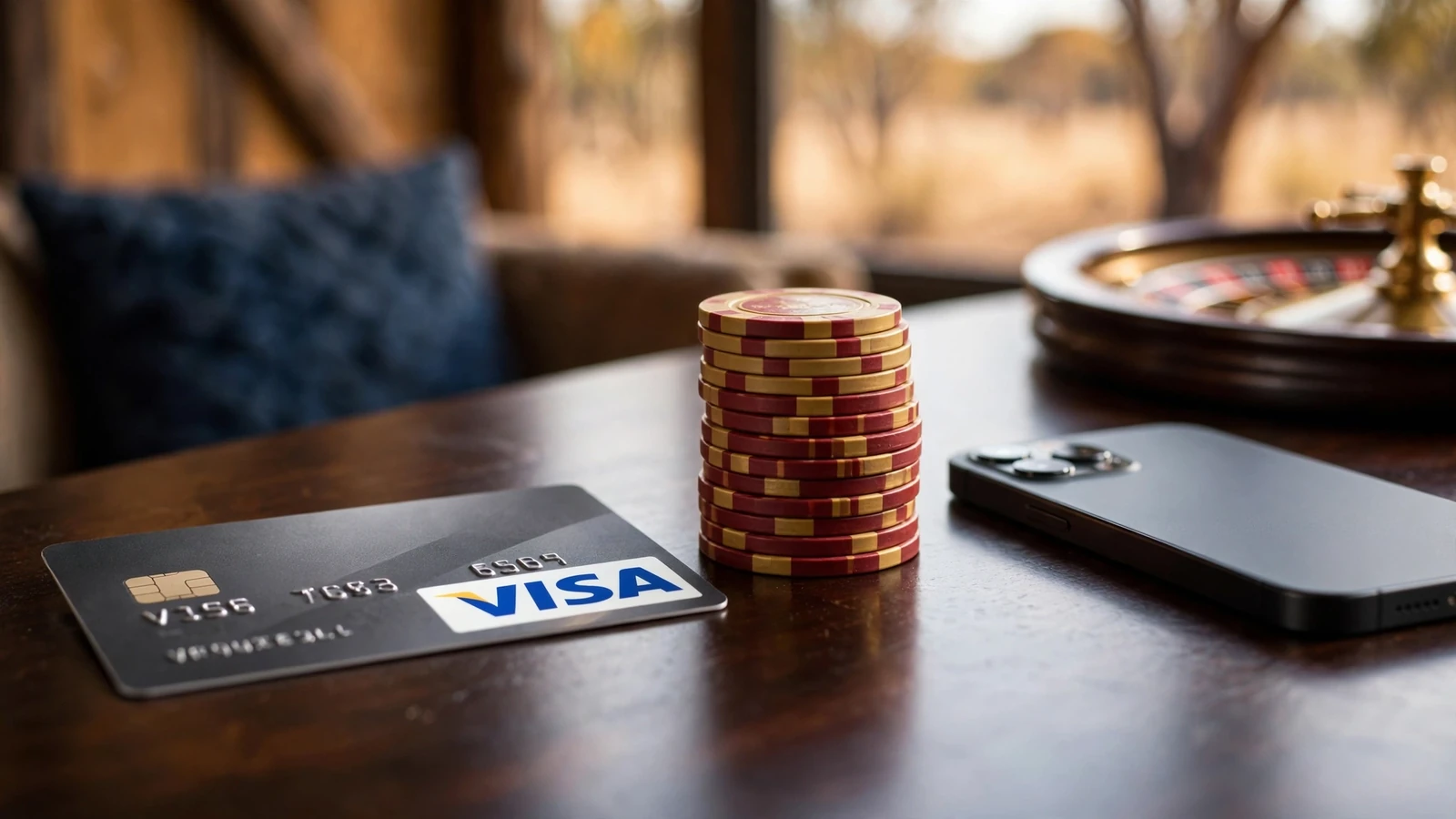
A Visa logo or a reference to Visa payments answers a narrow question: whether a payment route may be accepted. It does not establish that an online casino is authorised to offer services in Australia, that its site is available to Australian residents, or that a particular payment will be processed. Those are separate matters, and treating them as one can make a payment detail look like an endorsement.
A specialist review has reported that Visa may be accepted more broadly than American Express at Australian-facing online casinos. That is a limited comparison, not a guarantee about any operator or a measure of how many sites accept Visa. Payment options can differ between operators and change over time. The careful reading is simply that Visa may have wider acceptance than Amex in the comparison described—not that every casino takes Visa, or that a casino taking it is suitable or lawful for an Australian player.
The distinction matters when you see phrases such as “Visa accepted” or “pay by Visa.” They describe a possible payment capability, not the status of the service behind it. A card network’s presence in a cashier cannot confer permission on an operator. Nor does a familiar payment brand verify that a site is reachable, that an account can be opened, or that a transaction will succeed. Each claim would require its own evidence.
If you’re looking for a casino to use with Visa in Australia, check the current payment options and terms before you deposit. These verdicts highlight the available operator details, but the information provided does not confirm Visa acceptance.
Playfina Casino
Playfina is listed with a Curacao eGaming licence held by Hollycorn N.V. since 2017. Its minimum deposit is A$20–30, depending on the offer.
House of Pokies
House of Pokies lists PayID payouts of 1–24 hours and a minimum deposit of A$30, or A$10 via PayID. Its source describes its licence as international but does not name the jurisdiction.
Wild Tokyo
Wild Tokyo lists a Curacao licence and a minimum deposit of A$10. Its stated payout times are 30–60 minutes for crypto and 1–5 days for fiat.
DragonSlots Casino
DragonSlots Casino is listed with a Curacao Gaming Authority licence held by Jumpman Gaming Ltd.
Kingmaker
Kingmaker lists a minimum deposit of A$30. Its stated payout times are around 90 minutes for crypto and 1–5 days for fiat.
7Bit Casino
7Bit Casino is listed as operating under a Curacao licence, with Dama N.V. named as its operator.
MrPacho
MrPacho lists a minimum deposit of A$30. Its stated payout times are 30–120 minutes for crypto and 24–72 hours for fiat.
Vegaz Casino
Vegaz Casino is listed with Curacao licence OGL/2024/1335/0780. Its minimum deposit is EUR 20.
LevelUp Casino
LevelUp Casino is listed with Curacao eGaming licence OGL/2023/174/0082, held by Dama N.V. Its minimum deposit is A$15.
Rollero Casino
Rollero Casino is listed with a Curacao Gaming Control Board licence, OGL/2023/176/0095, held by Hollycorn N.V.
There is also a legal boundary that payment language should not blur. Under the Interactive Gambling Act 2001, operators are prohibited from providing real-money online casino games to people located in Australia. The Australian Communications and Media Authority enforces the Act. So a page describing an offshore casino as accepting Visa does not make that service locally approved. The payment statement and the operator’s legal position are different questions.
“Broader” is comparative, not comprehensive. A method can be more widely listed than another and still be unavailable at a particular operator, blocked for a particular transaction, or unsupported for a particular customer.
This is why a search for an Australian casino that accepts Visa can produce a misleadingly simple answer. The phrase joins two ideas—location and payment support—but neither proves the other. An offshore operator may present payment information to Australian visitors without being permitted to provide online casino services to them. Conversely, a payment method appearing in general casino material does not show that an Australian customer can use it. A logo is not a licence.
The same caution applies to labels such as “Australian Visa casino” or “Visa pokies.” They can sound like a distinct, locally approved category, but the card detail does not create one. Visa acceptance should be read only as a claim about a possible payment option. It cannot serve as a shortcut for assessing whether a service is lawful, accessible, or appropriate for you.
Australian consumer law does not protect players using offshore casinos. That is another reason not to treat payment branding as assurance: the presence of a recognisable card method does not provide the protections associated with a locally approved casino service. The method may be familiar. The legal and consumer position is not thereby changed.
That relative acceptance says nothing decisive about a named casino, a successful payment, or local approval. Payment capability is one criterion, and only one. Different question entirely.
A card logo does not tell you whether a particular merchant can process a payment. For any card transaction, the relevant details are the merchant’s stated payment options, the card issuer’s rules and the terms shown before you submit. A Visa card therefore cannot be treated as a guaranteed route simply because Visa is widely recognised.
For Australians, there is an additional boundary: the Interactive Gambling Act 2001 makes it illegal for operators to provide real-money online casino games to people physically located in Australia. A payment screen does not change that rule.
Legal Restriction
Under the Interactive Gambling Act 2001, it is illegal for operators to provide real-money online casino games to people physically located in Australia.
Acceptance should be stated for the exact card type and the transaction you are considering. A reference to “cards” alone may not tell you whether Visa is included, whether the card must be debit or credit, or whether the stated option applies to deposits rather than other transactions. A payment method shown in general site material is not, by itself, confirmation that a payment will be approved.
The same care applies to claims about American Express. A specialist review has reported that deposits with Amex are available at some online casinos, while also noting that some casinos do not accept it. Those reports describe a changing set of operator policies, not a rule that applies across the market. They cannot establish Visa acceptance, either.
Where an operator offers Amex deposits, the described process is to choose Amex in the cashier, enter the card details and the deposit amount in Australian dollars, then submit the payment. This is a description of the Amex procedure, not a template that confirms how Visa transactions work. Treating one card’s instructions as proof for another would be a poor shortcut.
The cashier is the place where a payment option and its transaction conditions are presented. Read the wording there carefully rather than assuming that a card accepted for one purpose is accepted for every purpose. If the information is unclear, do not infer acceptance from a logo or from a broad statement about card payments.
Even when a payment method is listed, that does not guarantee that a transaction will be authorised. The card issuer may have its own rules, and the operator’s stated options may differ by account or transaction. A declined payment does not establish that the card is generally unsupported; equally, a successful payment elsewhere does not prove that it will work with another merchant.
Before entering any card information, check what the payment page says about the card type and the transaction. Avoid relying on old reviews or copied descriptions as though they were current cashier instructions. The practical criterion is clear, direct information for the specific payment—not a general claim that a site accepts cards.
The Amex procedure described for deposits specifies an amount in AUD. That detail is useful when reading a payment screen: check the displayed currency and the amount before any transaction is submitted. Do not assume that a figure shown in another currency will be processed as the same AUD amount. The displayed terms matter.
No card-deposit description makes an online casino offer lawful for Australian residents. The Interactive Gambling Act places the responsibility on operators not to provide real-money online casino games to people in Australia. A card logo, a cashier menu or an overseas payment option does not alter that position.
The useful distinction is between a payment claim and permission to provide the underlying service. A review’s statement about Amex availability is narrow and time-sensitive; it is not a recommendation, a Visa confirmation or an assurance that a transaction can be made. Clear wording matters. A logo is not enough.
When comparing Visa with American Express, acceptance is the relevant distinction—not a promise that either card will work at every online casino. A specialist review reports that Visa may be accepted more broadly than American Express at Australian-facing online casinos. The same type of review notes that some casinos do not accept American Express. These are qualified observations, not a guarantee about a particular cashier or a permanent description of the market.
That gives you a narrow but useful comparison criterion: if your priority is the chance that a card brand will be listed, the reported distinction favours Visa over American Express. “Favours” is the careful word here. It does not mean every casino takes Visa, nor that American Express is unavailable everywhere. It says only that Visa may have wider acceptance between these two options.
| Comparison point | Visa | American Express |
|---|---|---|
| Relative acceptance described in a specialist review | May be more broadly accepted | May be accepted at fewer casinos |
| Universal acceptance established? | No | No |
| Practical implication | Still needs confirmation for the specific service | Some casinos do not accept it |
The table is deliberately modest. A card brand’s relative reach does not identify which sites accept it, confirm that an account can use it, or establish that a payment will be approved. Acceptance can be presented as a simple yes-or-no label, but your decision should turn on the exact casino and the card you intend to use. A general comparison cannot settle an individual case.
There is also a difference between “more broadly accepted” and “better.” If your only criterion is reported acceptance across casinos, Visa has the advantage in this comparison. If you are judging by another factor, these acceptance observations do not decide the result. They provide no basis for ranking cards on cost, transaction limits, speed, or withdrawals. Those are separate questions, not hidden consequences of the acceptance comparison.
The same distinction matters when you see a site described as accepting Visa. That label is not proof that every Visa card, account, or transaction will be accepted. Nor does the label establish that American Express is also available. The useful comparison is therefore not a blanket claim that one brand works and the other does not; it is a prompt to check the stated payment options for the particular service before relying on either card.
For American Express, the reported limitation is concrete but narrow: some online casinos do not accept it. That does not establish how many, which ones, or whether the position will remain unchanged. Treat a claim about acceptance as specific to the service and current conditions, rather than as a standing feature of the whole market. The same caution applies in the other direction: Visa’s possible broader acceptance does not amount to universal coverage.
A specialist review reports that Visa may be accepted more broadly than American Express at Australian-facing online casinos, though neither is universally accepted.
A practical comparison can be reduced to three questions: which brand is named, whether the statement applies to the specific casino you are assessing, and whether you are comparing acceptance alone or another feature. Keep those criteria separate. Otherwise, a modest difference in reported availability can turn into an unsupported claim that a card is the best choice overall.
On acceptance alone, Visa may have the broader reach; American Express is not accepted by some casinos. Neither statement selects a site for you, and neither card can be treated as a guaranteed route. A narrower claim is a more useful one.
A withdrawal estimate is useful only when it applies to the payment method and the operator handling the request. An American Express withdrawal timeline should not be treated as a Visa estimate: the cards have different acceptance conditions, and one card’s stated processing period cannot establish how quickly another will be paid.
A specialist review reports that an Amex casino withdrawal can take as long as five days to clear. Treat that as a reported timeframe, not a promise that every request will be completed within that period. The casino’s own payment rules determine whether it offers Amex withdrawals and what conditions apply. A processing estimate is not a guarantee.
There is also an eligibility condition: to withdraw through Amex, you must first have deposited using Amex. If that earlier deposit was made with another card, the Amex withdrawal route may not be available under this condition. That makes the deposit history relevant when you assess whether a particular withdrawal method can be used; it does not establish that an Amex withdrawal will be offered in every case.
A specialist review also notes that not all online casinos serving Australian customers allow withdrawals to Amex. Availability is therefore operator-specific, rather than something to assume from the presence of a card brand in a payment menu. A listed deposit method does not, by itself, tell you that the same method can receive withdrawals.
For a practical comparison, separate three questions:
These distinctions matter because “card accepted” can refer to deposits, withdrawals, or both. A payment page may describe one function without confirming the other. Read the withdrawal terms as their own set of conditions, rather than assuming that a card’s ability to fund an account also means it can receive funds back.
The same caution applies to timing language. “Clearing” describes the period reported for an Amex withdrawal; it should not be read as a universal end-to-end timetable for every casino or card. The operator’s payment rules and the card used both matter. A familiar card logo is not a timetable.
If you are comparing Visa withdrawal options, use a Visa-specific statement from the relevant operator rather than borrowing the Amex timeframe. Do not infer Visa speed from Amex acceptance, an Amex deposit, or an Amex withdrawal report. The useful comparison is the actual withdrawal method, its eligibility rules and its stated timing—not the general label “card payment.”
Amex Withdrawal Process
Deposit
First, you must have made a deposit using American Express.
Selection
Choose Amex in the cashier as the withdrawal destination.
Processing
Wait for the funds to clear, which a specialist review reports can take up to five days.
For Amex, the reported timing and the prior-deposit condition give you two concrete points to check. For Visa, rely on Visa-specific withdrawal terms. That is the only sound way to compare expected timing without turning one card’s conditions into another card’s promise.
For Australian readers, a card’s acceptance is separate from the legal status of the service taking the payment. A website might display Visa as a payment option, but that does not make its online casino offering lawful in Australia. The relevant boundary is set by the Interactive Gambling Act 2001, which prohibits operators from offering online casino games to people in Australia.
That distinction matters when you are assessing casino sites that accept Visa. Payment information can tell you how an operator says a transaction works; it cannot establish that the operator may legally provide casino services to Australian residents. A “Visa accepted” label is not a regulatory status. It is a payment claim, and a limited one at that.
The law is directed at providers. The Act does not explicitly make it a crime for an individual to use an offshore casino. That does not turn offshore gambling into a protected or locally approved service. It means the legal position for the operator and the player is not the same. Avoid treating the absence of an explicit player offence as an endorsement, or as evidence that a site is permitted to serve people in Australia.
The Australian Communications and Media Authority, or ACMA, is responsible for enforcing the Interactive Gambling Act. Its role is part of the regulatory picture, but an operator’s payment page should not be mistaken for an assurance about its standing under Australian law. The practical test is not whether a casino takes Visa, Visa Debit or another card. The legal question is whether the service is being offered to people in Australia in a way the Act prohibits.
There is another important limit for anyone considering an offshore site: Australian consumer law does not protect players using offshore casinos. If a dispute arises, you should not assume that the protections available in a domestic consumer transaction will apply. A familiar card brand, Australian-dollar display or Australian-facing website does not by itself provide that protection.
This changes how to read claims about a casino that allows Visa. Compare payment details only as payment details; do not use them to infer that the operator is locally authorised, that Australian consumer protections apply, or that the service is lawful to offer here. A payment route cannot settle those questions.
Consumer Protection
Australian consumer law does not protect players using offshore casinos, regardless of the payment method used.
Keep the two tests separate: whether a payment method is presented as accepted, and whether the underlying online casino service may legally be offered to people in Australia. The first is a transaction detail. The second is a matter of law. Similar wording, different questions.
Visa describes a way to pay; it does not describe what a gambling service offers. That distinction matters when you see references to casino games and Visa in the same sentence. The card brand and the games category answer different questions, and one does not establish the other.
A payment method does not determine a service’s catalogue. Nor does a reference to Visa establish that a particular service supports Visa payments, that a transaction will be accepted, or that any game category is available to you. Those are separate matters, each subject to its own conditions. A phrase such as “Visa casino games” can blur the distinction, but it does not identify a special class of games or a payment feature built into them.
The same applies to searches for casino games using Visa or games with Visa. Read such wording as a loose reference to payment and entertainment appearing together, not as proof that the card itself unlocks particular content. The payment route and the content category remain independent. One may be discussed without confirming the other.
There is also a difference between a payment screen and the process required before a financial transaction. Online gambling services commonly ask customers to complete identity checks, known as Know Your Customer assessments, before handling financial activity. That review concerns customer verification; it does not define a game category or guarantee that a card transaction will proceed.
Keep the comparison criterion clear: if you are considering payment access, look for information about payment conditions; if you are identifying a service category, look for information about the service itself. Do not treat a card label as evidence about content, or a games label as evidence about card support. The terms may sit side by side, but they are not interchangeable.
This is why “Visa casino payment options” should be read as a question about payment arrangements, not as a description of what can be played. Likewise, a reference to Visa alongside casino games is not, by itself, confirmation of a working payment route. The card is a means of payment, not a game feature. Different question, different answer.
Australian consumers are comfortable moving between cards, mobile wallets and services linked to bank accounts, such as PayPal. That flexibility describes how people handle payments generally; it does not confirm that a particular online service accepts every option.
For you, the useful distinction is between a familiar payment method and one supported by a specific merchant. A Visa card may be part of your everyday payment mix, while a mobile wallet or bank-linked service may suit another transaction. Familiarity with those options does not establish that an Australian casino accepts Visa, or that Visa can be used for a particular payment there.
Keep the comparison criterion clear: general payment habits tell you what Australians are comfortable using, not what an individual service permits. The same applies when you see a reference to an Australian casino using Visa. The wording alone is not evidence of current card support. Availability is a separate question from whether people commonly switch among payment types.
It helps to think of payment choice as a set of routes rather than a single default. You may use a card for one purchase, a mobile wallet for another, and a bank-linked service elsewhere. That pattern says nothing by itself about whether those routes are available for online gambling transactions. A service’s own payment terms, where relevant, would determine what it supports; broad consumer behaviour cannot substitute for them.
So if you are assessing a Visa casino in Australia, treat the words “Visa” and “Australian” as separate pieces of information, not proof of a working combination. The broader habit is switching between payment services. It is not a guarantee that all Visa casinos—or any particular one—will accept your card. Familiar, not confirmed.
A casino accepting Visa for a payment does not, by itself, establish that it will send withdrawals back to the same card. For a Visa withdrawal, the relevant criterion is the casino’s own withdrawal policy: whether Visa is listed as an eligible destination and what conditions apply. Card acceptance at one stage is not proof of acceptance at another.
A specialist review reported that some casinos do not allow withdrawals to American Express. It also noted that casino-set deposit and withdrawal limits can differ. Those points concern American Express; they cannot be transferred to Visa as if the two cards had identical terms.
The same caution applies to a casino withdrawal described as “to Visa” in a payment menu or general payment information. Check that the wording applies to withdrawals, not only deposits, and read any conditions attached to the method. If the policy does not clearly state that Visa withdrawals are supported, do not treat the card’s presence elsewhere on the site as confirmation.
American Express also has a specific reported condition: a player must have deposited with Amex before withdrawing through it. That condition should not be assumed to apply to Visa. Nor should an Amex rule be used to predict whether a Visa withdrawal will be available, how much can be withdrawn, or how the casino will handle it.
For Australians comparing an online casino with withdrawal on Visa, keep the comparison narrow and practical: look for explicit Visa withdrawal eligibility in the operator’s terms, then check the limits and any applicable fees stated there. If the information is unclear, ask the operator before relying on Visa as the payout route. A payment logo is not a withdrawal promise.
The same applies to searches for Visa withdrawal pokies or a Visa withdrawal casino in Australia: the phrase alone says nothing about a particular operator’s payout conditions. The useful distinction is whether Visa is confirmed for withdrawals, rather than simply accepted for card payments. Without that distinction, “Visa accepted” answers only half the question.
In Australia, contactless credit and debit cards are accepted almost everywhere. Mobile wallets, including Google Pay and Apple Pay, are also accepted almost everywhere. That makes tapping a card or phone a familiar part of everyday payments, but it does not tell you whether a particular online service accepts Visa.
The distinction is the payment setting. A shop terminal can accept contactless cards while an online checkout has different payment options. Likewise, broad acceptance of mobile wallets in person does not establish that a wallet can be used with any particular online service. Familiarity at the till is not proof of online compatibility.
For a Visa casino payment method, the relevant question is not whether Australians commonly use cards. It is whether the specific online checkout lists Visa and permits that transaction. General payment habits cannot answer that. Nor does the availability of Visa at a physical merchant identify which online services accept it.
A useful comparison, then, is between everyday familiarity and service-specific support. Contactless cards and mobile wallets score highly on familiarity across Australian in-person payments. They offer no reliable measure of online casino acceptance. The winner depends on the criterion: for day-to-day tapping, local habits provide context; for an online transaction, only the stated options for that service are relevant.
This also applies when the payment is described as paying by Visa, using Visa at an online casino, or using a card for online gambling. Those phrases do not make the method available. The word “Visa” on a card, or in a general description of card use, is not confirmation that it will appear as an option in an online checkout. Small distinction. Important one.
Treat widespread contactless use as background about Australian payment culture, not as evidence about online casino support. A payment method can be common in shops and still have no established connection to a particular online checkout. The settings are different; the acceptance decision is specific.
A Visa payment option and a casino bonus are separate matters. Seeing Visa listed as a payment method does not establish that a cardholder qualifies for an offer, or that a particular offer is available. Payment acceptance alone cannot tell you whether a promotion has conditions tied to the account, the payment method or other eligibility criteria.
The same distinction applies when an offer mentions Visa. That wording does not, by itself, explain the applicable terms or show that every Visa cardholder is eligible. A casino Visa bonus should not be treated as a guaranteed benefit simply because Visa appears in a cashier or promotional description.
Before relying on any stated offer, read its full terms, including eligibility rules and any conditions affecting how it can be used. Do not assume that the payment method determines those rules. If the terms are unclear, the offer is not a sound basis for making a payment decision.
This distinction matters because the practical value of an offer depends on its actual conditions, not its label. A Visa bonus casino promotion could have rules that differ from another offer, even where both refer to the same card network. The relevant comparison is therefore not “Visa accepted” versus “Visa not accepted”; it is whether the offer’s written terms clearly apply to you.
For Australian readers, promotional language should not be mistaken for confirmation that an online casino service is lawful or available locally. A card logo is a payment detail, not proof of bonus eligibility or permission to use a service.
Limits are set by each casino and can vary; Amex limits are usually higher than those for Visa and Mastercard. Check the casino’s cashier for the limits that apply to your account and transaction.
Amex deposits typically have no fees, but a casino may apply a 1.5% surcharge, and currency conversion can incur a 3% fee. Withdrawal fees may also apply.
Some casinos do not allow withdrawals to Amex, and withdrawals generally require that you previously deposited using Amex. A withdrawal fee may apply.
Amex deposits typically have no fees, but a casino may apply a 1.5% surcharge or a 3% currency conversion fee.