A practical look at funding from AUD, comparing casino terms, and weighing SOL price, bonus and withdrawal risks.

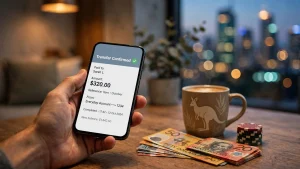
A Solana casino balance is funded with cryptocurrency, not Australian dollars. Most platforms do not take AUD directly by bank transfer or card, so the practical route is to buy SOL through an Australian exchange and send it to the wallet address shown by the casino. That creates a chain of separate steps: AUD enters the exchange, the exchange converts it to SOL, and SOL is transferred to the casino.
The distinction matters. An exchange account and a casino account are not the same wallet, and an AUD deposit to an exchange does not itself fund casino play. You need to complete the exchange purchase and then make a separate crypto transfer. A casino may describe its balance in SOL, but the asset you hold and send is still SOL; the phrase “casino coin” does not imply a separate token is needed.
Start by checking how the exchange accepts AUD and what account checks it requires. Swyftx, CoinSpot and Coinbase AU support AUD deposits by PayID or bank transfer. On-ramp services that convert AUD into crypto are subject to KYC/AML requirements, so expect identity and transaction checks as part of using the service. The exchange’s own instructions determine how you deposit AUD and place a SOL purchase.
Before buying, confirm that the casino accepts SOL and that the exchange can send it on the network the casino specifies. This is a compatibility check, not a detail to guess: selecting the wrong asset or network can send funds somewhere they cannot be recovered from. Follow the casino’s deposit instructions exactly, and compare the destination address character by character before authorising a transfer.
SOL transfers are irreversible. If you send to the wrong address, the funds can be lost permanently; there is no routine chargeback that reverses a blockchain transfer. Copying an address carefully and verifying it before sending are basic safeguards, not optional housekeeping.
Once the exchange purchase is complete, open the casino’s deposit area and request a SOL address. Check that it is specifically for SOL and that the casino has not provided a different address for another asset. Copy the address into the exchange withdrawal form, enter the amount you intend to transfer, and review the details before confirming.
Do not rely on an old saved address without checking it against the current deposit page. Nor should you treat a successful exchange withdrawal as proof that the casino has credited the balance: the exchange transfer and the casino’s account display are separate parts of the process. If the balance does not appear, use the casino’s stated deposit-support process and retain the transaction details.
The same care applies in reverse when you want to convert funds back to AUD. An off-ramp that converts SOL to AUD is also subject to KYC/AML requirements. The exchange or service handling that conversion may ask for identity information or review a transaction. So the route is not simply “win, then receive dollars”; it involves a crypto transfer and a conversion service.
A VPN does not make this route safer. Using one may lead to account seizure and loss of funds. Do not use it to conceal your location or bypass a platform’s restrictions.
A working deposit route says nothing about whether an offshore casino may lawfully serve Australian residents. Under the Interactive Gambling Act 2001, offshore operators are prohibited from offering online casino games to people in Australia. The law targets operators rather than directly penalising individual players, but that does not make using an offshore casino legally safe. ACMA can block unlicensed gambling websites, and Australian players have limited consumer protection and no Australian legal recourse if an offshore platform withholds funds or closes.
Keep those issues separate from the mechanics of buying and sending SOL. The exchange route explains how a crypto balance can be funded; it does not endorse a casino or remove the legal and consumer risks. It also does not establish that a particular site’s payment instructions, account practices or promises are reliable.
Funding a Casino
AUD to Exchange
Deposit AUD into an Australian exchange (such as Swyftx, CoinSpot, or Coinbase AU) via PayID or bank transfer.
Exchange to SOL
Purchase SOL using your deposited AUD within the exchange platform.
SOL to Casino
Transfer the SOL from your exchange account to the specific wallet address provided by the casino.
If you are considering a casino on Solana, first understand the route each transaction takes: AUD to an exchange, exchange purchase to SOL, then SOL to the casino wallet. Each handoff has its own instructions and checks. The practical convenience of using a digital asset should not obscure the key point: once SOL is sent to a casino address, recovering it may not be possible, and the surrounding service remains subject to Australian law.
A useful comparison separates what a platform claims from what you can check before depositing. For a Solana casino, the table should cover legal status, game information, fairness tools, account checks, withdrawal costs and cash-out conditions. A polished interface is not evidence for any of those.
The Australian legal position belongs at the top of the comparison, not in fine print. Under the Interactive Gambling Act 2001, offshore operators are prohibited from providing online casino games to Australian residents. The law targets operators rather than directly penalising individual players, but that does not make offshore play legally safe. The Australian Communications and Media Authority can block unlicensed gambling sites, and Australian players have no legal protection if an offshore casino freezes an account or withholds winnings. A foreign licence is not Australian approval.
Legal Risk
Under the Interactive Gambling Act 2001, offshore operators are prohibited from providing online casino games to Australian residents, leaving players with no local legal recourse.
| Criterion | What to look for |
|---|---|
| Licensing disclosure | The named regulator, jurisdiction and licence details, plus a way to check the claim with the regulator. Treat an undisclosed or unverifiable licence as a gap, not as proof of approval. |
| RTP | A return-to-player figure attached to the specific game or version, rather than a broad claim about the whole casino. Check whether the information is accessible before you play. |
| Provably fair tools | A clear explanation of how a result can be checked, what data you need and where the verification happens. A “provably fair” label alone does not demonstrate that a particular result is verifiable. |
| Withdrawal KYC policy | The terms explaining when identity documents may be requested, how account details are checked and whether bonus-related cash-outs receive additional review. |
| Fees and cash-out terms | The stated casino fee, any minimum or maximum withdrawal conditions, and the rules that could affect the amount you can cash out. |
These are verification points, not endorsements. In particular, a displayed licence should be checked against the regulator named on the casino’s own disclosure; the label by itself does not establish that the operator may serve people in Australia.
RTP and provably fair checks answer different questions. RTP is a statistical measure associated with a game over extended play, not a prediction of your result. A provably fair tool concerns the method used to generate or verify an individual result. Neither tells you whether a casino will process a withdrawal as promised.
Withdrawal comparisons also need two separate entries: the casino’s own processing and the Solana network transfer. Withdrawal speed depends on the operator’s internal handling as well as network conditions, so a fast blockchain does not settle how quickly a casino approves a request. A specialist review has reported casino withdrawal fees ranging from 0.1% to 1% of the amount; treat that as a reported range, not a fee schedule that applies across platforms. Check the current terms for the specific casino.
Read the cash-out rules before sending funds. Look for conditions attached to withdrawals, including any account review, bonus restrictions or fee that could change the amount received. Keep a copy of the terms you relied on. If a platform changes its rules or disputes a cash-out, Australian authorities do not provide the consumer recourse available for a locally regulated casino service.
Do not use a VPN to get around access restrictions. It can breach a platform’s terms and put an account or its funds at risk.
There is no meaningful universal winner without a criterion. A platform with clearer game data may compare better on transparency, while another may disclose withdrawal conditions more plainly; neither distinction overrides the Australian legal position. Compare evidence, not slogans. Check each claim separately.
When comparing Solana casinos in Australia for 2026, check the available licensing and payment details before deciding where to play. This list gives you a concise reference to the facts available for each operator.
Playfina Casino
Playfina Casino is listed with a Curacao eGaming licence held by Hollycorn N.V. since 2017. Its minimum deposit is A$20–30, depending on the offer.
House of Pokies
House of Pokies lists an international iGaming licence, though the source does not name the jurisdiction. PayID payouts are stated as taking 1–24 hours, and the minimum deposit is A$30, or A$10 when using PayID.
Wild Tokyo
Wild Tokyo is listed with a Curacao licence and a A$10 minimum deposit. Its stated payout times are 30–60 minutes for crypto and 1–5 days for fiat.
DragonSlots Casino
DragonSlots Casino is listed with a Curacao Gaming Authority licence held by Jumpman Gaming Ltd.
Kingmaker
Kingmaker has a A$30 minimum deposit. Its stated payout times are around 90 minutes for crypto and 1–5 days for fiat.
7Bit Casino
7Bit Casino is listed as operating under a Curacao licence, with Dama N.V. named as its operator.
MrPacho
MrPacho has a A$30 minimum deposit. Its stated payout times are 30–120 minutes for crypto and 24–72 hours for fiat.
Vegaz Casino
Vegaz Casino is listed with Curacao licence OGL/2024/1335/0780. Its minimum deposit is EUR 20.
LevelUp Casino
LevelUp Casino is listed with Curacao eGaming licence OGL/2023/174/0082, with Dama N.V. named as the operator. Its minimum deposit is A$15.
Rollero Casino
Rollero Casino is listed with Curacao Gaming Control Board licence OGL/2023/176/0095, held by Hollycorn N.V.
There is no useful universal winner among Solana casinos. A platform that suits you because its withdrawal process is clearly explained may be a poor fit if its bonus rules are difficult to follow. Start with the outcome you care about, then compare the evidence relevant to that outcome. “Best” only means something when the criterion is stated.
Separate the casino’s own processing from the Solana network’s work. A transfer can move quickly once an operator releases it, while the operator may still need to approve the request. Automated processing has been reported at 5–15 minutes, while manual processing can take as long as 72 hours. Those are different service patterns, not competing estimates of the same step.
Look for a published explanation of how a withdrawal is reviewed and what could delay it. A specialist review describes a fast Solana withdrawal as one that should take less than 10 minutes on the network; treat that as a benchmark to investigate, not a promise that every request will be completed in that time. Check whether the platform distinguishes approval time from transfer time. If it gives only a single headline figure, you cannot tell which part of the process it is describing.
A useful comparison table might have columns for the stated processing window, whether processing is automated or manual, and the circumstances that can prompt extra checks. Record what is actually disclosed. An empty cell is more informative than filling it with an assumption.
Compare the rules, not the size of the advertised offer. The key question is what must happen before bonus-related funds can be withdrawn. Winnings generated from bonus credit may remain unavailable for cash-out until you have placed the required real-money bets. That condition can change the practical value of an offer substantially.
Before you accept anything, find the full terms and note the wagering requirement, eligible games, expiry conditions and any cash-out restrictions. Do not infer the rules from a banner or a short promotional summary. If a condition is unclear, treat that as a comparison disadvantage: a generous headline cannot make an unreadable rule transparent.
You do not need to decide that every bonus is valuable. You need to determine whether its conditions fit the way you intend to play and whether you can understand the route from credit to withdrawable funds. If the terms cannot be located or explained plainly, the offer is not comparable on equal footing with one whose conditions are visible.
Use evidence that can be checked rather than labels such as “trusted” or “top-rated.” Read the operator’s terms alongside any independent assessments, and look for consistency between claims and the actual rules. A platform’s own statement is useful as a record of what it promises, but it is not independent confirmation that the promise will be honoured.
This distinction matters particularly in Australia. The Interactive Gambling Act 2001 prohibits offshore operators from providing online casino services to Australian residents. The law targets operators rather than directly penalising individual players, but that does not make using an offshore casino legally safe. Australian consumers also have limited protection and no Australian legal recourse if an offshore platform withholds funds or closes. A comparison score cannot remove that exposure.
Avoid treating access as proof of legitimacy. Offshore gambling sites may be blocked by the Australian Communications and Media Authority, and using a VPN to get around restrictions can expose your account and funds to seizure. A site being reachable at a particular moment is not a meaningful assurance.
Give each platform a simple record: what it states, where the statement appears, and whether the wording is specific enough to verify. Then compare only the criteria that matter to you. For predictable cash-outs, clarity about processing stages may matter more than a promotional offer. For bonus play, complete and understandable conditions may matter more than the advertised amount. For accountability, missing or contradictory terms are a serious weakness.
Do not turn this into a single score unless you are willing to explain how the score is weighted. A platform can perform well on one criterion and poorly on another. Your choice depends on which trade-off you are prepared to accept, not on a universal ranking.
Keep the comparison practical: write down the stated terms before depositing, and do not assume a fast network makes the casino’s own decisions fast. The distinction is simple. The consequences are not.
When a bonus is tied to slot play, the key figure is the game’s contribution rate: the share of each qualifying stake that counts toward the wagering requirement. Slot play is commonly credited in full, while blackjack and roulette may count for only a fraction—sometimes just 10–20%. That difference can make slots a more direct route through a slot-specific requirement, but it does not make the bonus automatically valuable.
Check which games qualify and how the contribution is applied before you play. A slot may count at a different rate from another game, or be excluded from a promotion altogether. If you switch to a table game while working through a requirement, your progress may advance more slowly. The relevant comparison is not simply “slots versus tables”; it is the stated contribution for the games covered by that particular offer.
Also establish what the requirement is calculated against. Some terms may base wagering on the bonus alone, while others can define the eligible balance differently. The wording matters: a large headline bonus can still require substantial play, and a full slot contribution only tells you how bets are counted. It says nothing by itself about the amount you must wager, the eligible games or whether winnings can be withdrawn.
Free spins can add another step. Their winnings may be placed in a bonus balance rather than made immediately withdrawable, then carry a separate wagering condition. A specialist review has reported an offer where that separate condition was 50x; treat that as an example of terms that may appear, not as a standard applying to every promotion.
Read the rules for the spin winnings as well as the rules for the original bonus. Confirm whether the balance is credited as cash or bonus funds, which games count, and what must happen before the resulting amount can be withdrawn. If the terms set a separate requirement, completing the original bonus condition may not clear it.
A useful way to assess a slot offer is to write down its conditions in order: the qualifying games, contribution rate, balance used to calculate wagering, time limit and any withdrawal restriction. Then consider whether you would play those slots at all without the promotion. If the bonus pushes you into games you would otherwise avoid, its apparent value may be less relevant than the extra play it demands.
For Solana slot play, the wagering rules are separate from the token used to fund an account. A SOL balance does not change how a casino calculates game contribution. Nor does a slot label prove that a particular game or promotion is available to Australian residents. Focus on the published terms, and do not treat a displayed progress bar as a substitute for understanding them.
Full contribution helps. Conditions still matter.
An NFT in a Solana wallet is not the same thing as a casino deposit. The fact that both may be associated with the Solana network does not mean a gambling platform can accept, use or value an NFT. Treat those as separate questions: which tokens the casino accepts, and whether it provides any specific NFT function.
A specialist review reports that some Solana casinos accept USDC on Solana for deposits and play as well as SOL. That is a limited claim about supported payment assets, not a general feature of every platform. It also does not establish that NFTs can be deposited, used as collateral, exchanged for credit or connected to game access.
Asset Distinction
SOL is the native network token, whereas USDC on Solana is a stablecoin; neither is interchangeable with NFTs, which are distinct digital items.
SOL is the network’s native token. USDC on Solana is a stablecoin issued as a token on that network. An NFT is a distinct kind of token, generally associated with a particular digital item or entitlement. Sharing a blockchain does not make these assets interchangeable.
For you, the practical distinction is the casino wallet’s accepted-asset list. If it names SOL, that supports a SOL transaction; if it names USDC on Solana, that indicates support for that token on that network. Neither statement should be read as support for NFTs. A platform that displays a Solana wallet address has not, by that fact alone, shown that it can process every Solana-based asset.
Network and token details matter. USDC on Solana should not be confused with USDC issued on another blockchain: a wallet or service may support one version and not the other. Before relying on a displayed deposit option, make sure the asset and network match the wallet you intend to use. A mismatch can make funds inaccessible.
A meaningful NFT feature would need clear terms stating what the NFT does, how it is connected to an account, and whether any value or benefit is involved. A graphic, badge or reference to a collection does not by itself establish that an NFT can be transferred into a casino wallet or used in play. Nor does owning an NFT prove that a casino recognises it.
If a platform describes an NFT benefit, read the conditions rather than inferring utility from the branding. Look for an explicit explanation of the supported wallet connection, eligible token or collection, and the effect on the account. Without those details, treat the NFT as separate from your playable balance.
The same caution applies to promotional wording. “Solana casino” can describe a service that accepts SOL, but it does not automatically mean that the service supports NFTs or every token on Solana. Asset support is specific, not implied.
For a casino with Solana payments, the useful question is therefore not whether it mentions NFTs, but whether its wallet terms identify the exact asset you plan to use and explain its function. Keep NFT ownership separate from funds available for play unless the platform’s terms clearly establish otherwise. A wallet connection is not a promise of utility.
Tax treatment depends on what you receive and what happens to the cryptocurrency, not simply on whether a gambling session ends in profit. In Australia, recreational gambling winnings are generally not taxed as income. SOL can create a separate tax question: the Australian Taxation Office regards cryptocurrency as an asset, so a gain connected with gambling in SOL may be subject to capital gains tax.
That distinction matters even when your balance never reaches an Australian bank account. A win recorded in SOL is not automatically a fixed amount of Australian dollars. Its value can move between the time you receive it and the time you later dispose of it, including when you convert it. Keep records that let you establish the relevant transactions and values, and seek advice from a qualified tax professional if you are unsure how the rules apply to your circumstances.
Losses do not necessarily cancel out gains. A specialist tax review notes that gambling losses can be deducted against gains only where the person qualifies as a professional gambler, a demanding classification rather than a label you can choose for convenience. Do not assume that a losing session creates a tax offset.
There are two exposures to keep distinct. One is the tax treatment of the gambling result; the other is the capital gain or loss associated with SOL. A favourable outcome in the game does not guarantee that the token’s AUD value will remain favourable by the time you cash out. If SOL falls in value, the winnings may buy less in Australia even if the number of SOL in your account has not changed. Price risk is real.
The legal setting matters too. Under the Interactive Gambling Act 2001, offshore operators are prohibited from providing online casino games to Australian residents. The law targets operators, not individual players, but that does not make using an offshore casino legally safe. If funds are withheld or an account is frozen, players have no legal protection under Australian law.
Treat the displayed SOL balance and its possible AUD value as different figures. For tax questions, get advice based on your own records and circumstances; a casino balance alone is not a tax calculation.
A dice game can make the difference between a quick blockchain transaction and a slow casino process especially visible. A SOL deposit may confirm on Solana rapidly, but that only describes the network transfer. It does not establish that a particular dice game is fair, that a casino has credited your account correctly, or that the operator will process a later withdrawal promptly.
A specialist review reports Solana transaction confirmation at about 400 milliseconds, with balances updating immediately. The same review puts the average transaction fee at US$0.00025, effectively a near-zero network cost. Treat those figures as descriptions of the network, not promises about every casino’s payment flow. A platform may need to detect a transfer and update its own records; network confirmation alone cannot tell you how that internal step works.
That distinction matters when you assess a dice casino using Solana. Fast confirmation can reduce the wait for an on-chain deposit to settle, and a low network fee means the blockchain charge itself is small. Neither tells you whether the dice game’s rules are transparent or whether its result-generation method can be independently checked. Those are properties of the game and operator, not of Solana.
Address accuracy is less forgiving than transaction speed. Before sending SOL, compare the casino’s displayed deposit address with the address entered in your wallet. Check that you are using the correct network and asset, and do not rely on a familiar-looking first or last character. If you send funds to the wrong address, the transfer is irreversible and the SOL may be permanently lost. There is no routine reversal button.
Attention: SOL transfers are irreversible; sending funds to the wrong address can result in the permanent loss of your assets.
A fast network does not make a mistaken transfer recoverable. Once you submit it, confirmation can happen before you have time to notice an error. Take the extra moment to verify the address and amount before approving the transaction. If the casino provides a deposit reference or other instructions, follow them as displayed; a confirmed transfer sent without required details may still need manual attention.
The same caution applies when comparing casinos de Solana for dice play: separate what the chain can demonstrate from what the platform claims. Solana can show that a transaction was sent and confirmed. It cannot certify the operator, validate a particular game, or guarantee that a credited balance matches the transfer. Fast settlement. No safety net.
A bonus is not worth its headline amount alone. Its practical value depends on how much wagering is required, which games count toward it, how long you have to complete the requirement and whether a maximum cash-out limits the result. Read those conditions together before deciding that an offer gives you useful extra play.
The game category matters because a casino may count different bets at different rates. A wager that contributes only partly toward playthrough advances the requirement more slowly than one that counts in full. So a bonus tied to one category of play may be less useful to you if the games you prefer contribute less—or do not qualify. Check the terms for the games you intend to play, not just the general bonus headline.
Two examples reported in a specialist review show how the calculation can work. A 40x requirement attached to a 5 SOL bonus means 200 SOL must be wagered before withdrawal. A separate offer described a 35x requirement applying to the bonus alone. Those are specific terms, not a dependable template for other offers: the base used in the calculation changes the amount of wagering required. Confirm whether the requirement applies to the bonus, the deposit and bonus together, or another stated amount.
Bonus funds also do not automatically become withdrawable winnings. If play produces a balance from bonus funds, the applicable wagering conditions must be completed with real-money play before withdrawal. That distinction can make a displayed balance look more available than it is.
Time limits add another constraint. A requirement that appears manageable on paper may be difficult to finish within the stated period, particularly if only some games contribute. A cash-out cap can restrict what you keep even after completing the playthrough. A specialist review’s method for assessing effective bonus value accounts for playthrough, game contribution, time limits and maximum cash-out caps; looking at only one of those terms misses the point.
For a fair comparison, write down the qualifying games, contribution rate, wagering base, deadline and any cap for each offer. Then assess the terms against the play you would actually make, rather than increasing your stakes to chase a bonus. The larger headline is not necessarily the better deal. Read the fine print first.
A balance shown in SOL is a quantity of cryptocurrency, not a guaranteed amount of Australian dollars. If SOL falls in value after you receive winnings but before you convert them, those winnings may buy less in AUD. A higher SOL price could move the value the other way, but neither outcome is fixed when you leave funds in the token.
That distinction matters when you assess a win. The number of SOL in your account can stay unchanged while its AUD value shifts. If you are measuring a result against rent, bills or another AUD expense, the token balance alone does not tell you what you will have available after conversion. Treat the displayed amount and its current AUD equivalent as separate figures.
Holding winnings in SOL therefore adds a price decision to the gambling result: convert promptly, or accept that the value may change while you hold the token. There is no guaranteed rate waiting at cash-out. A casino balance denominated in SOL is not the same as cash held at a fixed AUD value.
This is a different question from whether a platform supports SOL or describes itself as a Solana casino. A payment option tells you how the balance is recorded; it does not protect that balance from market movements. Nor does a list of leading casinos answer whether you want to keep winnings exposed to SOL’s price. The relevant criterion here is your tolerance for value changes between winning and converting.
There is also a tax distinction. The Australian Taxation Office regards cryptocurrency as an asset for capital gains tax purposes, so gambling with SOL can have capital gains tax consequences. Recreational gambling winnings and changes in the value of cryptocurrency are not interchangeable tax categories; consider the circumstances of your transactions and seek appropriate tax advice if needed.
Before deciding to retain winnings in SOL, consider what you would do if its AUD value fell before conversion. If that possibility would change whether the result feels like a win, a token balance may be a poor substitute for a fixed cash target. And remember: SOL transfers cannot be reversed. Sending tokens to the wrong address can mean permanent loss.
SOL itself is not prohibited in Australia: you can buy, hold and transfer it. The legal issue arises when it is used to gamble with an offshore operator. Under the *Interactive Gambling Act 2001*, overseas operators are prohibited from offering online casino services to people in Australia. That covers real-money casino games, including slots and table games.
The law targets the operator, rather than directly penalising an Australian player for using an offshore casino. That distinction does not make the activity legally safe. A lack of direct player penalties is not approval, and it does not remove the risks of using a service that is prohibited from serving Australian residents.
The Australian Communications and Media Authority (ACMA) enforces the Act and can block access to unlicensed offshore gambling websites. A site that loads today may therefore become inaccessible. A block is not the same as a resolution of any dispute over your account or funds.
There is also limited consumer recourse. If an offshore casino freezes your account, withholds winnings or closes, you have no Australian legal protection for recovering those funds through the usual local consumer channels. A foreign licence, if displayed, does not turn the operator into an Australian-licensed casino or override the prohibition.
Using a VPN does not change the underlying restriction. It may also breach a platform’s terms and put your account or funds at risk. Do not treat access as evidence that an offshore casino is permitted to serve you. The legal position is uneven: SOL transfers are lawful, while the casino service receiving them is prohibited from offering online casino games to Australian residents.
There is no Australian approval framework specifically for crypto-gambling operators, and offshore operators are prohibited from offering online casino games to Australian residents. Any comparison should account for the legal and consumer-protection risks, including the possibility of blocked sites and no Australian legal recourse if funds are withheld.
You can buy SOL through an Australian exchange that accepts AUD, then send it to the casino’s verified SOL deposit address. Check the asset and network carefully before sending, because transfers are irreversible; using an offshore casino also carries legal and consumer-protection risks.
Winnings from recreational gambling are generally not taxable, but the ATO treats cryptocurrency as an asset, and profits from gambling with SOL are subject to capital gains tax. Gambling losses can offset gains only if you qualify as a professional gambler, which is a high bar.
Solana transactions confirm in about 400 milliseconds, and balances can update immediately. Withdrawals depend on the casino’s processing: automated operators may take 5–15 minutes, while manual processing can take up to 72 hours; native SOL withdrawals on competent platforms typically take 30–60 seconds once processed.
Minimum deposits typically range from 0.01 to 0.1 SOL. The average Solana transaction fee is about US$0.00025, though some casinos charge withdrawal fees of 0.1%–1%; transfer confirmation takes about 400 milliseconds, while casino withdrawal processing can range from 5–15 minutes to up to 72 hours.
Most Solana casinos do not accept AUD directly by bank transfer or card. You generally need to buy SOL through an Australian exchange using PayID or bank transfer, then transfer it to the casino.
Buy SOL through an exchange, open the casino’s deposit area, and request an address specifically for SOL. Enter that address in the exchange withdrawal form, check the address and network carefully, then confirm the transfer; sending SOL to the wrong address can result in permanent loss.