Learn how wallet funding and payouts differ, what to check for Australian access, and why bonus terms and verification matter.
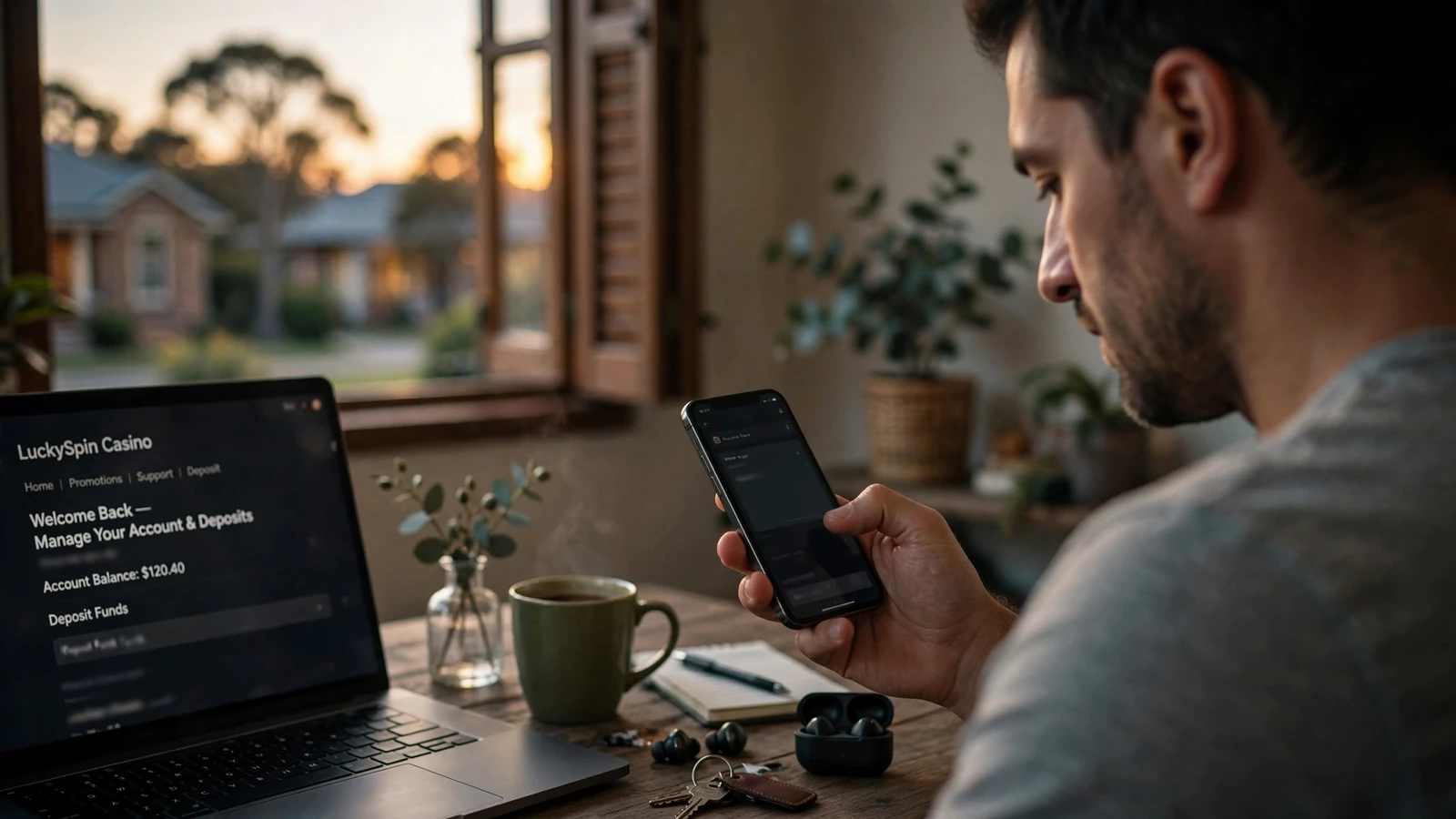
An e-wallet sits between your payment source and a casino account. You move funds into the wallet, then use its balance to make a deposit where that wallet is accepted. If withdrawals to the same wallet are permitted, money can travel back through it rather than going straight to a bank account. That two-way role is the practical reason e-wallets appear in both parts of the payment journey.
MiFinity, Skrill and Neteller are examples of wallets used for deposits as well as withdrawals. Their presence on a payment page does not, by itself, establish that every wallet works for both directions at that casino. The important distinction is between a method that can fund an account and one the operator will also use to pay out. Check the stated rules for the particular wallet before treating it as a complete route.
For a deposit, the wallet is the payment instrument selected at the casino cashier. You follow the payment instructions, confirm the transaction through the wallet, and the casino account is credited according to the handling of that transaction. The wallet is not the casino account itself: its balance and your casino balance remain separate.
When choosing an online pokies site with an e-wallet in mind, check whether your preferred payment method is supported and review the relevant terms before depositing. Use these verdicts as a concise guide to the details available for each option.
Playfina Casino
You can note that Playfina Casino has a Curacao eGaming licence held by Hollycorn N.V. since 2017. Its minimum deposit is A$20–30, depending on the offer.
House of Pokies
You have a stated PayID payout window of 1–24 hours at House of Pokies, with a minimum deposit of A$30 or A$10 when using PayID. The source describes its licence as international but does not name the jurisdiction.
Wild Tokyo
You can consider Wild Tokyo for its stated Curacao licence and A$10 minimum deposit. Its listed payout times are 30–60 minutes for crypto and 1–5 days for fiat.
DragonSlots Casino
You can identify DragonSlots Casino by its Curacao Gaming Authority licence, associated with Jumpman Gaming Ltd.
Kingmaker
You have a stated minimum deposit of A$30 at Kingmaker. Its listed payout times are about 90 minutes for crypto and 1–5 days for fiat.
7Bit Casino
You can note that 7Bit Casino is described as Curacao-licensed and operated by Dama N.V.
MrPacho
You can note MrPacho’s stated minimum deposit of A$30. Its listed payout times are 30–120 minutes for crypto and 24–72 hours for fiat.
Vegaz Casino
You can identify Vegaz Casino by its Curacao licence, OGL/2024/1335/0780. Its stated minimum deposit is EUR 20.
LevelUp Casino
You can note LevelUp Casino’s Curacao eGaming licence, OGL/2023/174/0082, associated with Dama N.V. Its stated minimum deposit is A$15.
Rollero Casino
You can identify Rollero Casino by its Curacao Gaming Control Board licence, OGL/2023/176/0095, associated with Hollycorn N.V.
A withdrawal reverses the direction, but it is not simply a deposit played backwards. A casino may process a payout only after its own review, and its available withdrawal methods may differ from its deposit methods. So a wallet shown beside the deposit option should not be assumed to be a cashout option too. The cashier’s labels and the written payment terms are more useful than the wallet logo alone.
This makes the e-wallet method appealing to people who want one payment service to be part of both stages. The convenience is in having a familiar intermediary and a possible route back to that intermediary; it is not a promise that the casino will approve every transaction or offer the same route to every account. A tidy diagram, not a guarantee.
Treat each wallet as a separate option, not as a generic category. Check whether it is listed for deposits, withdrawals, or both; whether the account details you plan to use match the casino’s requirements; and whether the casino describes any additional steps before releasing funds. If the terms are unclear, ask support to confirm the specific wallet and direction of payment before you send money.
Also compare the wallet’s role with your own needs. If you mainly need a way to fund an account, deposit availability is the relevant criterion. If you expect to withdraw through the same service, payout eligibility matters more. Where both are supported, using one method across the journey may make the route easier to follow, but it still leaves the casino’s processing and approval rules in place.
A specialist review reports that e-wallet withdrawals may reach the wallet within 24 hours after the casino’s pending period. Read that as a reported processing expectation, not a fixed arrival time: the pending period comes first, and a casino’s own handling can affect when a payout is sent. The wallet cannot remove a delay that occurs before the casino releases the transaction.
Before making a payment, check that you can access the wallet account and review its transaction history. Keep the deposit confirmation and any later payout reference, so you can distinguish a casino-side delay from a wallet-side status. If the casino marks a withdrawal as sent but the wallet does not show it, those records give support a clearer starting point than a general report that the money is missing.
Avoid choosing an e-wallet solely because its name appears in a cashier. Confirm the exact method and its permitted use in the payment terms, and consider whether you can use that same wallet if you need a payout. The better fit is the option that supports the stage you care about and has rules you understand—not simply the one with the most familiar branding.
E-wallets can make deposits and withdrawals part of a recognisable payment route, but they do not make the two stages identical. Depositing is a payment into the casino account; withdrawing depends on the operator’s payout process and the methods it allows. Check both sides before relying on the wallet. Better to know first.
An e-wallet can be part of the payment process at an offshore casino, but it does not change the legal position of the service. Paying through an e-wallet, signing in on a phone or using a desktop browser are access and payment choices; none makes an offshore casino an Australian-regulated operator.
The Interactive Gambling Act 2001 prohibits operators from offering real-money online casino-style games to people located in Australia. That includes casino games such as pokies. The restriction concerns the operator providing the service in Australia.
The Act does not make it illegal for an individual Australian to play at an offshore mobile casino. That distinction matters: the operator’s conduct and an individual punter’s position are not the same legal question. It does not, however, mean that an offshore service is approved, supervised or protected under Australia’s casino rules.
Offshore crypto-friendly casinos are not Australian-regulated. If one accepts Australian customers, that does not give it local regulatory status. Nor should an offshore licence be mistaken for Australian oversight: a licence issued elsewhere is not the same as regulation by an Australian government body. The service may have its own rules for accounts, identity checks, payments and disputes, but those are not an Australian government complaints process.
If an offshore casino refuses to pay winnings, there is no Australian government body you can complain to for help resolving that payout dispute. This is a practical limit, not a technicality. Before relying on an account or its displayed balance, understand that you may have little recourse in Australia if the operator and customer disagree.
You must be at least 18 to register and gamble in Australia. A login page being reachable does not override that threshold, and an existing account does not establish that the service is locally authorised.
When you enter credentials, you are accessing the operator’s account system, not an Australian-regulated service. Keep that distinction in view if a login is unavailable, an account is restricted or access changes. The fact that a site once loaded—or that an e-wallet login and casino login are separate steps—does not promise continued access or settle a dispute about the account.
The name of a payment method cannot make a prohibited operator offer lawful. A smooth sign-in is not a regulatory check.
The Australian Communications and Media Authority (ACMA) works to restrict access to illegal gambling websites, so an offshore casino may be blocked from Australian users. A failed page load or an access warning can reflect that restriction; it is not necessarily a fault with your device or password.
VPN Risks
Using a VPN to access a blocked casino may breach the operator's terms, potentially leading to voided winnings or account closure.
A VPN may appear to change the route by which you connect, but using one to reach a blocked casino carries a direct account risk. The operator may treat access through a VPN as a breach of its terms, and winnings may be voided or the account closed. A VPN also does not turn the service into an Australian-regulated casino or remove the operator’s obligations under Australian law.
Do not assume that being able to log in means the site is authorised to serve customers in Australia. Equally, do not assume that a VPN makes a blocked site safe to use. If access is restricted, attempting to get around the block can leave you with less protection, not more. An offshore operator’s decision to accept an account is not a substitute for local oversight, and an e-wallet transaction cannot supply that oversight either.
The practical comparison is stark: individual play is not prohibited by the Act, while operators are prohibited from offering these services to people in Australia. Yet a punter using an offshore service faces access blocks and has no Australian government complaints body if the operator withholds winnings. Legal position and practical protection are separate questions. That distinction is easy to miss.
A page that mentions Australia is not proof that an offshore casino accepts people located there. Before treating an offer as available, check the operator’s own terms for country restrictions and confirm that Australia is explicitly included. If the wording is unclear or contradictory, do not deposit on the assumption that the cashier will accept you or that you will be allowed to keep an account.
Look for this information in the terms of service, registration flow and responsible-gambling or eligibility pages. Check whether the restriction applies to Australian residents, people physically in Australia, or both: those descriptions are not automatically interchangeable. Also check whether the terms distinguish between creating an account, depositing, playing and withdrawing. An account form that lets you enter an Australian address does not, by itself, establish that all those activities are permitted under the operator’s rules.
Treat the operator’s stated country policy as a condition to verify, not as a promise. Pages can be outdated, and promotional material may not spell out restrictions as clearly as account terms do. If the operator’s terms say Australia is excluded, or its support gives an answer that conflicts with the written rules, the site should not be treated as available to you. Keep the decision simple: unclear access is not confirmed access.
Next, identify the jurisdiction the operator says issued its licence. Casinos that accept Australian players may state a connection to Curaçao, the Malta Gaming Authority (MGA) or Gibraltar. These are examples of jurisdictions that appear in this market, not evidence that a particular operator is licensed, that its licence is current, or that it is permitted to serve people in Australia.
Read the licence statement on the site and compare it with the operator’s legal terms. The details should point to the same operating entity and jurisdiction; a logo or a brief claim on a landing page is not a substitute for consistent information. If the site names one jurisdiction in its footer and another in its terms, or does not clearly identify who holds the licence, treat that as a material uncertainty rather than filling in the gap yourself.
No Local Recourse
There is no Australian government body available to help you recover winnings if an offshore casino refuses to pay.
A foreign licence is not an Australian licence. It does not make an offshore casino Australian-regulated, and it does not remove the legal restrictions on operators offering real-money online casino games to people in Australia. Nor should a familiar jurisdiction name be read as a guarantee about payment handling or dispute outcomes. The jurisdiction is one part of the operator’s identity; it is not a complete answer to whether you should trust the offer.
That distinction matters if a disagreement arises. There is no Australian government body you can complain to for help recovering winnings from an offshore casino that refuses to pay. A site’s own complaints route or an overseas licensing process is not the same as Australian consumer protection or a local regulator resolving the matter for you. Read the withdrawal and dispute terms before sharing personal information or funds, and do not assume that an attractive Australia-facing page creates local recourse.
If access is blocked from your location, a VPN is not a reliable workaround. Using one to reach a blocked casino may breach the operator’s terms, and the operator may void winnings or close the account. It can also make location and identity checks harder to resolve. A site loading in your browser does not establish that your location is accepted; the operator’s eligibility terms are the relevant check.
The same caution applies to an offshore, crypto-friendly casino that appears tailored to Australian visitors. That description identifies the kind of service being presented, not a recommendation or confirmation that it is legally available to you. Do not infer acceptance from Australian currency references, local payment logos, Australian-themed wording or a page that opens without an error. Confirm the location policy directly before depositing, and do not proceed if the operator’s answer is ambiguous.
A useful check is therefore a short sequence: establish what the written terms say about Australia; identify the jurisdiction the operator claims; see whether the legal entity and licence details are consistent; then decide whether the remaining uncertainty is acceptable. If any of those points cannot be verified, the offer has not passed the check. Availability should be demonstrated by clear terms, not guessed from a welcome page.
For an AUD deposit, compare three separate things: how quickly a payment is credited, whether the method is offered for your location, and what might cause it to fail. A payment method appearing on a cashier page does not establish that it will work with your bank or account. Before making any deposit, confirm that the site accepts your location and check its current payment terms.
A specialist review describes PayID deposits as near-instant and typically free. Treat that as a report about the method, not a promise that every operator supports it or that every transfer will arrive on the same schedule. Availability can depend on the site’s cashier options and the details shown when you select the method. If timing matters, read the payment instructions before submitting a transfer and check how the operator identifies a successful payment.
| Method | Speed and availability to weigh | Main practical check |
|---|---|---|
| PayID | A specialist review reports near-instant deposits; availability varies by operator. | Confirm that PayID is currently listed for your account and follow the displayed payment instructions. |
| POLi | No longer processes local transactions. | Do not rely on an old cashier listing or guide as evidence that it remains usable. |
| BPAY | Reported as a mobile deposit option, with processing times that vary. | Check the operator’s current instructions and stated processing time. |
| Cards | Reported as a deposit option, but approval is not assured. | Your bank may block or flag a gambling-related charge. |
| Cryptocurrency | Reported as a mobile deposit option, with processing times that vary. | Check the operator’s instructions and any network requirements before proceeding. |
This comparison is about making a deposit, not withdrawing funds. The same payment label can have different practical value depending on whether it is available to you and whether the payment clears as expected. A method that is quick when it works is not necessarily the most dependable choice for every punter.
POLi stopped operating in Australia in September 2023 and no longer processes local transactions. That date matters because older pages may still name it alongside active-looking payment choices. A listing can remain visible after the service itself has stopped handling local payments; it should not be treated as proof that you can complete a transaction.
The useful distinction is between a method that appears in an old description and one that is actually supported now. If POLi appears in a cashier or guide, verify the claim with the operator before taking any further step. Do not send money using substitute details or instructions that you cannot confirm through the site’s own payment information.
Cards are reported among the deposit methods available on mobile casino cashiers, but a card option on screen does not guarantee acceptance. Some Australian banks block or flag gambling-related card charges, which can result in a declined or failed payment. A rejection may therefore reflect the bank’s handling of the transaction, rather than a simple typing error.
A specialist review reports this possibility, but it does not establish how any particular bank will handle a charge. If a card payment fails, check the transaction status with your bank and the operator before trying again. Repeating a payment without confirming whether the first attempt was completed can make it harder to understand what has happened. Do not assume that changing the amount or switching devices will resolve a bank restriction.
Bank Restrictions
Some Australian banks may block or flag gambling-related card charges, which can cause a payment to be declined regardless of the operator's available methods.
BPAY and cryptocurrency are also reported as mobile deposit options, but their processing times vary. That is a reason to rely on the current payment instructions, not on a general label such as “fast.” Check whether the method is available for your account, what steps the operator requires, and how it says a completed payment will be recognised. For cryptocurrency, follow the displayed network and address instructions carefully; a transaction sent using incorrect details may not be recoverable.
A specialist review lists PayID, POLi, BPAY, cards and cryptocurrency as mobile deposit methods, while also noting variation in processing times. That list should be read as a description of possible options, not a universal menu. Availability can change between operators and over time. Verify the cashier before making a decision.
If speed is your main criterion, PayID has the clearest reported advantage, but only where the operator currently offers it and the transfer is accepted. If avoiding a card decline matters more, the relevant question is whether a non-card method is available to you—not whether it is advertised in a general guide. If you are checking an older source, POLi is the option to rule out: it ceased local Australian operations in September 2023.
No route is automatically better for every punter. Compare the current listing, the stated processing information and the possibility of a failed payment. A payment option is useful only when it is genuinely available to your location and you can follow its instructions with confidence.
A mobile casino does not necessarily come with an app. For Australian users, the usual starting point is a website opened in a phone’s browser. The same account can generally be used on desktop and mobile, so changing devices does not itself mean creating a separate profile.
That distinction matters when you see an “app” mentioned. It may mean a browser shortcut, a downloadable file offered by an operator, or a social game from an official app store. These are different products with different access and security considerations. The icon on your home screen does not tell you which one you have.
Most mobile access is through a browser rather than an app-store download. You visit the site, sign in to your existing account and use the mobile version of its pages. Casino operators that accept Australian players typically rely on this format or a Progressive Web App (PWA) instead of a native mobile app.
A browser session is not a separate kind of account. It is another way to reach the website. If you are checking a site on a phone, look for the address bar and confirm that you are on the operator’s website rather than an unrelated page or an imitation download prompt. Bookmarking the site can make later visits easier, but a bookmark remains a browser shortcut; it does not turn the website into a native app.
The practical criterion is access, not the label. Browser play avoids installing a separate casino program, while still letting you use the mobile site. If the site does not offer a dedicated app, that is not unusual in this market. Casino apps are rarely listed on Google Play or Apple’s App Store in Australia, which is why browser access is the default.
A Progressive Web App is a shortcut to a casino website designed to behave more like an app on a mobile device. If the site presents an install or add-to-home-screen prompt, you can tap it and confirm to place the shortcut on your device. It then provides a more app-like way to reopen the site.
The key difference from a native app is its source: a PWA is installed through the website, not downloaded as a conventional app-store product. It does not create a new casino account, and the underlying service remains the website. If you remove the shortcut, that does not mean you have closed your account.
For someone who wants quick access without searching for the site each time, a PWA may be the more convenient format. For someone who prefers not to add anything to the phone, the mobile browser does the job. Neither format should be treated as proof that an operator is trustworthy or that its service is available to you.
Before depositing, confirm that the site accepts your location. Offshore crypto-friendly casinos are not Australian-regulated, and there is no Australian government body to complain to if one refuses to pay winnings. A VPN used to reach a blocked casino may breach its terms, void winnings or result in account closure. Convenience is not a substitute for checking access conditions.
A native app is a program installed on the device, rather than a website opened in a browser or a website shortcut added to the home screen. Because casino apps are rarely available through the major app stores in Australia, a site that directs you to download an installation file elsewhere needs more scrutiny.
Sideloaded casino apps carry security risks. Their safety depends on the operator, and a download prompt alone cannot establish that the file is safe. Consider whether you trust the operator and whether you understand what you are installing before proceeding. If you cannot verify the app’s source, using the browser version avoids that particular download decision.
An app-store listing also needs context: social and free-play casino apps using virtual credits are available through Google Play and Apple’s App Store and are legal to use in Australia. They are not the same thing as an offshore real-money casino app. Virtual credits distinguish the social format; the shared casino-style appearance does not make the services interchangeable.
| Format | How you access it | Main distinction |
|---|---|---|
| Mobile browser | Open the site in your phone’s browser | No separate casino app is required |
| PWA | Add the website shortcut from its prompt | Website access presented in an app-like form |
| Native app | Install a program on the device | Sideloaded versions carry security risks that depend on the operator |
| Social or free-play app | Download through an official app store | Uses virtual credits rather than real-money casino play |
If your priority is avoiding extra software, the browser is the straightforward choice. If you prefer a home-screen shortcut, a PWA offers that format while remaining tied to the website. A sideloaded app adds an installation and security decision; it is not automatically the better mobile option.
Keep the comparison simple: identify what is being installed, where it comes from, and whether it is a real-money service or a virtual-credit social game. Those details matter more than whether the operator calls it an app.
An e-wallet cashout is not simply a deposit in reverse. Before you transfer funds to an offshore crypto-friendly casino, check what the operator requires to approve a withdrawal, which payment methods it permits for cashouts and whether a cap could split a larger balance into separate payments. These conditions can matter more than the payment label.
Expect the first withdrawal to involve identity verification. Casinos commonly ask for a selfie or identity document, along with proof of address. The purpose is to confirm that the account and payment request belong to the same person, but the practical effect is that an unverified withdrawal may wait while documents are reviewed.
Read the verification instructions before sending files. Check which documents are accepted, how they must be submitted and whether the details on your account match your identification. If the casino asks for further evidence, respond through its stated account or support process. Keep copies of what you submit and note the status of the request; that gives you a clearer record if the payout stalls.
Verification is especially relevant at the first cashout, not just when you open an account. A successful deposit does not establish that a later withdrawal will pass review automatically. Allow for the possibility that the casino will request documents when you try to withdraw.
Do not assume every payment option shown at the cashier works in both directions. Some casinos require you to withdraw through the method used to deposit, while some methods are deposit-only. That can leave you needing another payout route even when the original deposit went through without difficulty.
Before depositing, look for the withdrawal rules in the cashier information and payment terms. Confirm that the e-wallet you intend to use is supported for cashouts, whether it must match your deposit method, and what alternatives are available if it cannot receive a payout. Check the account name and payment details as well: a mismatch can complicate verification.
The useful comparison is not simply “e-wallet versus bank.” It is whether the method is eligible for withdrawals, what checks apply, and how long the operator’s own processing stage may take.
Specialist casino-payment reviews report that e-wallet and cryptocurrency withdrawals can be processed in under 24 hours. Treat that as a reported timeframe, not a guarantee for an individual request: verification, the casino’s pending period and its processing queue can affect when the transfer is sent.
Bank transfers can take up to five business days, according to the same kind of specialist review. That longer window is a reason to compare the stated method timings before choosing how to cash out. It does not mean every bank transfer will take that long, or that an e-wallet payout will arrive as soon as you press the withdrawal button.
Separate the casino’s approval time from the payment provider’s transfer time. A status marked pending may mean the casino has not yet released the funds. Ask support which stage is holding the request if the published timeframe passes.
Some casinos set weekly or monthly withdrawal ceilings. Specialist casino-payment reviews describe limits in the range of $4,000–$10,000 per week at some operators; the applicable figure and period depend on the casino’s terms. A cap can mean a large balance must be paid in instalments, so compare the limit and any rules for repeat requests before depositing.
These checks concern offshore operators, not Australian-regulated casinos. Confirm that a site accepts your location before depositing. If an offshore casino refuses to pay, there is no Australian government body you can complain to for recovery. Using a VPN to reach a blocked casino may void winnings or lead to account closure.
A no-deposit offer can still come with conditions that determine whether you can turn bonus play into a withdrawal. The label describes how the offer starts; it does not tell you how much wagering is required, which games count, or what happens when the offer expires. Treat the terms as part of the offer, not fine print to inspect after claiming.
A specialist review reports welcome-bonus wagering requirements in the range of 30x to 50x the bonus amount. The multiplier matters because it sets the amount of qualifying play required before any eligible winnings can be withdrawn. Requirements above 40x are considered steep, but the practical burden also depends on which games contribute to wagering and whether the offer has a cashout cap.
Time limits change the calculation. A specialist review says many bonuses must be cleared within 7–10 days; if the deadline passes, the bonus is lost. A short window may leave little room to complete the wagering, particularly if only certain games count. Check when the clock begins, what activity qualifies, and whether the terms say that unused bonus funds or winnings are removed at expiry.
Before claiming, verify:
These terms work together. A smaller-looking wagering requirement may still be difficult to clear if eligible games are restricted or the deadline is tight. A generous headline can also have limited value if a cashout cap limits what can be withdrawn. The better offer depends on your criterion: less wagering, more time, fewer game exclusions, or a higher cap. Compare those conditions rather than the promotional wording.
If the terms are unclear about how wagering is counted or what happens at expiry, do not assume the more favourable interpretation. Read the full bonus rules before accepting. A bonus you cannot realistically clear is not extra value.
Yes. Most casinos that accept Australian players are accessed through a mobile browser, usually with the same account you use on desktop. Some also offer a Progressive Web App shortcut.
Yes, individual players are not prohibited by the Interactive Gambling Act 2001 from playing at offshore mobile casinos. However, the Act prohibits operators from offering online casino-style games to people in Australia, and offshore casinos are not Australian-regulated.
No. Browser play is the default, and some casinos offer a Progressive Web App that you can add to your home screen instead of downloading a native app.
A mobile browser is the usual option for Australian players, since casino apps are rarely listed in the Australian Google Play Store or Apple App Store. Some casinos offer a Progressive Web App shortcut that behaves more like an app.
E-wallet withdrawals typically arrive within 24 hours after the casino's pending period, while bank transfers can take up to five business days. A first withdrawal usually requires KYC verification, which can affect processing.
An offshore casino that accepts Australian players is not thereby Australian-regulated or protected by Australian casino rules. Check the operator's licence and payment terms, and remember that an offshore licence is not Australian government oversight.