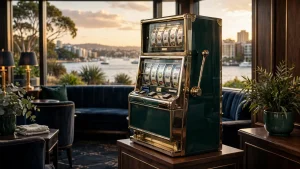
High volatility means significant wins may be less frequent, with long gaps between them; it describes a payout pattern, not a forecast.

A high-volatility pokie is defined by the shape of its payouts: significant wins are less frequent, but can be larger when they arrive. The gaps between them may be long. That is the practical meaning behind the label, not a promise that a particular spin will pay or that a large win is waiting after a run of losses.
This pattern can make a session feel uneven. You may see stretches in which the balance moves without a significant payout, followed by a much larger result. The central feature is the contrast between those dry spells and the possibility of a rare, substantial win. High volatility describes that broad payout pattern; it does not tell you exactly when a result will occur.
When you see “high volatility” attached to a slot machine, read it as information about how payouts tend to be distributed over play. It does not mean that every win will be large, nor that every session will contain a large win. A label describes the game’s general character, not the outcome of the next spin or the result you can expect before you stop playing.
High-volatility slots can bring larger swings, so it helps to check the details of a casino before you play. Use this list as a starting point, and check the volatility of the specific games you’re considering.
Playfina Casino
Playfina is listed with a Curacao eGaming licence held by Hollycorn N.V. since 2017. The minimum deposit is A$20–30, depending on the offer.
House of Pokies
House of Pokies lists PayID payouts at 1–24 hours and a minimum deposit of A$30, or A$10 with PayID. Its source describes an international iGaming licence but does not name the jurisdiction.
Wild Tokyo
Wild Tokyo lists a Curacao licence and a minimum deposit of A$10. Its stated payout times are 30–60 minutes for crypto and 1–5 days for fiat.
DragonSlots Casino
DragonSlots Casino is listed with a Curacao Gaming Authority licence held by Jumpman Gaming Ltd. That licensing detail is the available point of reference for you.
Kingmaker
Kingmaker lists a minimum deposit of A$30. Its stated payout times are about 90 minutes for crypto and 1–5 days for fiat.
7Bit Casino
7Bit Casino is listed as operating under a Curacao licence, with Dama N.V. named as the operator. These are the available details for you to check.
MrPacho
MrPacho lists a minimum deposit of A$30. Its stated payout times are 30–120 minutes for crypto and 24–72 hours for fiat.
Vegaz Casino
Vegaz Casino is listed with Curacao licence OGL/2024/1335/0780 and a minimum deposit of EUR 20. Check the currency and amount before you deposit.
LevelUp Casino
LevelUp Casino is listed with Curacao eGaming licence OGL/2023/174/0082, with Dama N.V. named as the operator. Its minimum deposit is A$15.
Rollero Casino
Rollero Casino is listed with Curacao Gaming Control Board licence OGL/2023/176/0095, held by Hollycorn N.V. This licensing information is the available detail for you to review.
That distinction matters because a long quiet stretch can feel as though it must lead somewhere. It does not. The volatility label offers no timetable for a significant payout. A large win may be rare, and the gap before one may be longer than you would prefer. The game can therefore feel slow even when its advertised character includes the possibility of a substantial result.
The phrase “high volatility meaning slots” is sometimes used as though it identifies a special feature that activates on demand. It does not. Volatility is a way to describe the payout pattern, not a button, bonus state or signal that a feature is close. A high-volatility slot machine can produce a dry spell without that spell being evidence of anything about what comes next.
The payout pattern is a general description, while a session is a limited slice of play. In one session, you might encounter a significant payout; in another, you might experience only the quieter part of the pattern. Neither experience changes what the label means. The name does not ensure that the larger outcomes appear within the time you play.
That is why a high-volatility game can feel more dramatic than its label sounds. The contrast between limited progress and a rare larger payout draws attention to the wait. A sequence without a significant result can seem especially frustrating when you are expecting the game’s defining feature to show itself. But “high volatility” is not a countdown. It describes a tendency, not a sequence that must finish with a win.
Nor does a larger possible payout make every result valuable to you. The defining trade-off is about frequency and size: significant payouts arrive less often, with the potential for larger returns when they do. The label does not, by itself, say how enjoyable a particular session will be or whether the outcome will suit your expectations.
The wording can sound more precise than it is. “High” is not a measurement of how long you will wait, and “volatility” is not a forecast of the next result. It signals that the payout pattern is associated with rare larger wins and extended gaps between significant payouts. It cannot identify which spin will pay, how much you will receive, or whether your session will include a major win.
So, if you are asking what a high-volatility slot machine means, focus on the pattern rather than the promise: fewer significant payouts, potentially larger wins, and longer dry spells. The same description applies when people refer to high-volatility slot machines or high-volatility casino games. The label explains the character of the payouts; it does not make them predictable.
A quiet run is part of the possible experience, not proof that a large payout is due. And a large payout is a possibility, not an outcome guaranteed by the game’s category. High volatility is a description of the ride, not a destination.
There is no single best high-volatility pokie for every player. The useful comparison is between the payout pattern you are willing to accept and the one you actually want from a game. High-volatility play can bring rare large wins; lower-volatility play tends to bring smaller wins more often. Neither pattern makes a particular result certain.
Start with your response to uneven outcomes. If you can accept a game that may produce little to celebrate for a while in exchange for the possibility of a larger payout, a high-volatility option may better match your preferences. If you would rather see smaller wins more frequently, its opposite may be a more comfortable fit. That is a difference in experience, not proof that one choice is better value or more likely to leave you ahead.
A useful way to compare choices is to write down the criterion before you play:
| Your priority | Pattern to consider |
|---|---|
| The possibility of a rare, larger win | High volatility |
| Smaller wins appearing more often | Low volatility |
| A guaranteed return | Neither pattern provides one |
That last row matters. A preference for larger potential payouts does not turn them into an expected outcome. “Best” only has meaning once you define the criterion: a game suited to someone who accepts a more uneven payout pattern may be a poor match for someone who values frequent smaller wins.
Think about what you would consider a satisfying session, without treating that preference as a prediction. If you enjoy the possibility of a standout win and can tolerate the fact that it may not arrive, high volatility may suit your appetite for risk. If long stretches without a meaningful payout would make the session unpleasant, choosing a game for its potential top-end result may not fit how you want to play.
This is a personal distinction, not a test of nerve. You do not need to prove that you can tolerate larger swings, and choosing a less volatile game is not a lesser choice. The right fit is the one whose payout pattern you understand and are prepared to accept.
Keep the comparison narrow. A title’s name, theme or visual style does not tell you whether its payout pattern matches your risk tolerance. Nor does the phrase “high volatility” promise that a rare large win will occur during your play. It describes a kind of outcome pattern, not a result you can schedule.
When you encounter claims about the best high-volatility pokies in Australia, apply the same standard: what criterion is being used? A ranking based on personal preference may not help you if it does not explain whether the preference is for larger potential wins or for more frequent, smaller ones. The label alone cannot decide for you.
Before choosing, picture two different experiences. In one, wins are smaller but occur more often. In the other, larger wins are possible but less frequent. Which pattern would leave you more comfortable with your decision, even if the larger result never appeared? Answering that is more useful than asking which category sounds more exciting.
If your answer depends on needing a large win, pause. High volatility offers no assurance that one will arrive. A hoped-for payout should not be treated as a reason to keep playing, and a disappointing result does not change which pattern you chose. Your preference can guide the choice; it cannot control the outcome.
The same principle applies when you compare more than one high-volatility game. Do not assume that the shared label makes their experiences identical, or that a striking theme is evidence of a better fit. Focus on what you can assess: whether you want the possibility of rarer, larger wins, or would be more comfortable with smaller wins appearing more frequently. Avoid turning a preference into a prediction.
Set a budget before you start, and never wager more than you can afford to lose. That limit is part of the decision, not an adjustment to make after results disappoint. A high-volatility choice can suit someone willing to accept uncertainty, but it cannot remove the financial risk or promise a favourable session.
For a practical decision, use one criterion at a time. If your priority is the possibility of a rare large win, high volatility may align with it. If your priority is seeing smaller wins more often, low volatility may be the closer fit. If you require a guaranteed payout, neither is suitable. The better choice depends on what you value and what uncertainty you can accept. No universal winner.
For anyone looking into high-volatility online slots, the first distinction is legal rather than technical: Australian law places responsibility on the operator, not the player. Under the *Interactive Gambling Act 2001*, businesses cannot legally provide online pokies to people in Australia. The same prohibition covers other real-money online casino games, including poker and table games. A person who plays does not face a penalty under this law.
That does not make the service lawful. The prohibition applies to providing the gambling service to people in Australia, even when the operator is based overseas. Advertising real-money online casino services to Australians is also prohibited. So a site being accessible, or describing its games as high-volatility pokies, should not be confused with having permission to offer them here.
There is no online pokie site licensed in Australia. Sites that offer online pokies to Australians operate under overseas licences, rather than a local Australian online casino licence. An overseas licence does not override the Australian rule against providing these services to people in the country.
This matters when you see claims about licensing. A licence issued elsewhere is not an Australian authorisation, and it does not change the legal status of offering online pokies to Australian residents. Nor does a site’s apparent availability establish that it has been approved by Australian authorities. The key question is not whether a provider uses familiar language or has a licence in another jurisdiction; it is whether the service may legally be offered to people in Australia.
The Australian Communications and Media Authority, usually shortened to ACMA, oversees compliance with federal interactive gambling laws and enforces the *Interactive Gambling Act 2001*. Its work includes responding to prohibited services that target or reach Australians.
ACMA can ask internet service providers in Australia to block websites that provide prohibited interactive gambling services or advertise them locally. Blocking is an enforcement measure, not a licensing process: it does not turn a blocked site into an authorised one, and a site that remains reachable has not thereby been declared lawful.
Legal Warning
Under the Interactive Gambling Act 2001, it is illegal for businesses to provide online pokies or advertise real-money online casino services to people in Australia.
Since enforcement began, ACMA has blocked more than 1,455 illegal gambling and affiliate websites following enforcement action. The reported number of illegal services that have withdrawn from the Australian market since 2017 is not consistent: one account puts it above 210, while another gives a figure above 190. These are different reported totals, not a single agreed count.
Website blocking can affect whether a particular service is reachable, but access and legality are separate matters. A site may be blocked after ACMA action, while another may still load; neither circumstance creates an Australian licence. Likewise, a website’s claims about its games, payment options or offshore credentials do not amount to approval under Australian law.
This is relevant if you are comparing high-volatility pokies in Australia. The volatility label describes a game’s payout pattern; it says nothing about whether the operator is legally allowed to offer that game here. A review, ranking or promotional page cannot change that distinction. Keep legal status separate from the game description.
Payment rules are another part of the local framework. Credit cards are banned for online gambling in Australia. A payment method appearing on an offshore site does not make the underlying service lawful, and the availability of a method should not be read as confirmation that it may be used for online gambling in Australia.
The practical summary is straightforward: operators cannot legally offer online pokies to Australians, and players are not penalised under the stated law. No online pokie site holds an Australian licence; sites offering these games operate under offshore licences. ACMA monitors compliance and can seek website blocking as an enforcement tool. A high-volatility game remains a game description, not a legal status.
For your session, high volatility is less a promise of a dramatic result than a description of how uneven the wait may feel. Significant payouts are rare, and dry spells can stretch between them. When a larger win does arrive, it may stand out against that quieter run. The gap between those moments is the practical part to plan around.
That pattern changes how long a balance can feel as though it is lasting. If your play continues through a run without a significant payout, the balance may shrink while you wait. A deeper bankroll is associated with high-volatility pokies because it gives more room for that uneven pattern; it does not make a large win certain or ensure that one arrives during your session.
The useful question is not whether the volatility label sounds attractive. It is whether your budget can withstand a session in which the wait is longer than you hoped. If a short dry spell would make you feel pressure to keep playing, the possibility of extended gaps matters more than the appeal of a rare large payout.
A rare large win can draw attention, but it does not describe what every stretch of play will feel like. The experience may instead be a sequence of spins without a significant payout. That is not evidence that a larger result is about to arrive. Nor does a longer wait turn the next spin into a more promising one.
Attention: A longer wait for a payout does not make the next spin more promising, nor does it mean a win is more likely to occur.
This is why a high-volatility game can feel demanding even when its potential for a substantial payout is part of its appeal. You are managing the possibility of a long interval without a meaningful return, not simply waiting through a brief pause before a feature. A balance that cannot absorb that kind of interval may run out before a feature triggers. The feature is not obliged to keep your schedule.
Before you begin, set a budget that reflects what you can afford to lose, and do not wager more than that amount. Treat the budget as a firm limit rather than a target you must use up. If the session reaches that limit without a significant payout, stop; adding money does not make the wait safer. Smaller, disciplined stakes can help reduce the speed at which a bankroll is depleted, but they cannot remove the uncertainty or guarantee that a feature will appear.
A deeper bankroll should not be confused with permission to spend more than you can afford. It describes the greater financial room associated with this payout pattern, not a reason to stretch your limit. If the money set aside for play is small, the balance may disappear before a feature triggers. That possibility belongs in your decision before the first spin, not as a surprise halfway through a session.
The label is useful only when you connect it to your own tolerance for uncertainty and your budget. If you are prepared for extended dry spells and can stop within a set limit, the pattern may suit the way you choose to play. If you need frequent reassurance from payouts, the gaps may feel frustrating. Neither reaction changes the game’s pattern; it changes whether that pattern is comfortable for you.
Keep the distinction clear: a possible large payout is not a forecast for your session. The practical cost of high volatility is that you may spend time and bankroll waiting without a significant result. Decide what you can afford before playing, and let that limit—not the hope of ending the wait—determine when the session ends.
RTP and volatility describe different aspects of a pokie’s payout pattern. RTP indicates its theoretical return over extended play; volatility describes how that return may be distributed. A high RTP does not tell you when a win will arrive, while high volatility signals that payouts may be less frequent and larger when they occur.
That distinction matters when comparing high-volatility pokies with different RTPs. A higher RTP may look appealing as a long-run measure, but it is not a forecast for your next session. It cannot tell you how many spins will pass without a payout, whether a feature will trigger, or whether your results will match the theoretical return. Short sessions can end well above or below that figure.
| Measure | What it tells you | What it cannot promise |
|---|---|---|
| RTP | The game’s theoretical return over extended play | The result of an individual session |
| Volatility | The broad pattern and frequency of payouts | When a particular win or feature will occur |
So, when you see a high-RTP, high-volatility game, read both labels together rather than treating one as a correction to the other. The RTP describes the long-run return measure; the volatility describes the uneven path payouts can take. Neither makes the outcome of a short session predictable.
Bonus structure can add another consideration. Games with multiple bonus stages may pay out less frequently because low RTP and high volatility can combine in that format. A sequence of features may look substantial on screen, but reaching or playing through a bonus does not establish that the session will finish in profit. Even a bonus round with a large payout can leave you with no overall profit after the stakes involved.
Use RTP as a comparison point, not a personal target. It is useful for understanding a game’s stated long-run profile, but it cannot tell you whether a particular run will be favourable. Pair it with the volatility label and the game’s structure, then decide whether that uncertainty suits your budget. Set a budget before playing and never wager more than you can afford to lose.
A percentage is not a timetable.
The practical difference is the shape of the payouts. High-volatility pokies can deliver large wins, but those wins are rare. Low-volatility games tend to return smaller wins more often. Neither pattern makes a game the better choice for every player; the useful criterion is which kind of result you are prepared to experience.
| What matters to you | High volatility | Low volatility |
|---|---|---|
| Typical payout pattern | Larger wins can occur, but less often | Smaller wins occur more frequently |
| What you may prefer | The possibility of a rare, larger payout | More frequent, smaller payouts |
| Main trade-off | A less frequent payout pattern | A more frequent payout pattern |
This comparison describes tendencies, not a promise about what a session will deliver. A low-volatility game does not guarantee frequent wins in your session, and choosing high volatility does not make a large payout more likely on a particular spin. The label helps you compare payout styles; it cannot tell you which game will pay you.
So, is high or low volatility better for pokies? Better by which criterion? If your preference is for the possibility of a larger win and you can accept that such wins are rare, high volatility may suit that preference. If you would rather encounter smaller wins more often, low volatility may feel like a closer fit. That is a choice about the pattern you want, not evidence that either option gives you an advantage.
The comparison also does not make one style safer for your budget. More frequent small wins are not the same as a guaranteed return, just as a rare large win is not a dependable way to recover losses. Set a budget before playing, and never wager more than you can afford to lose. A budget is a boundary, not a prediction.
Keep the decision modest: choose a payout pattern you can tolerate without treating it as a route to profit. No system beats a pokie. Each spin is independent of earlier results, and every spin carries a built-in house edge. A run of small wins does not establish that a low-volatility game will continue paying; a dry spell does not make a high-volatility win due. The useful choice is the one whose pattern matches your preference, with no promise attached.
Decide what you are prepared to spend before opening a pokie, then treat that amount as a firm limit. Never wager money you need for bills, essentials or other commitments, and do not add to the budget after losses. A spending limit is useful only if it stays fixed.
With high-volatility pokies, smaller, controlled stakes help slow the rate at which your balance is used. Larger stakes can make a session consume its budget faster, while a modest balance may run out before a feature appears. Neither a bigger stake nor extra deposits make a feature due; they only change how quickly you put money at risk.
A practical check is to choose a stake that leaves room for the session to continue without relying on a payout to replenish your balance. If that stake feels too small to be worthwhile, the game may not fit the budget you have set. That is a mismatch, not a reason to raise the limit.
Keep the budget separate from money set aside for everyday needs, and stop when it is gone. Do not borrow, chase losses or treat a rare large win as something your spending plan can count on. A deeper bankroll may be needed to withstand extended dry spells, but having more available does not ensure a payout.
The comparison is straightforward: a smaller stake can preserve your balance for longer, while a larger one can use it up more quickly. Choose the amount by what you can comfortably lose, not by the size of a possible win. Set the limit first. Keep it fixed.
Two features can make high volatility slot games pay less often, but they do so in different ways: one adds bonus stages, while the other builds a jackpot from wagers.
A game may require you to move through several bonus stages before a substantial payout becomes possible. That structure can mean fewer payouts, particularly when low RTP combines with high volatility. Reaching a bonus is not the same as finishing with a profit: a bonus round can produce a large payout and still leave your overall result below what you wagered.
The distinction matters when you assess a game. A layered feature may offer more steps and outcomes to follow, but those steps do not make a payout more dependable. Treat the feature as part of the game’s payout structure, not as a route that must eventually pay.
More stages, not certainty.
A progressive jackpot grows as a portion of each wager is added to the prize pool. Because part of each bet contributes to that accumulating amount, progressive pokies pay out less frequently and are generally high volatility. The larger headline prize does not change the basic trade-off: a growing jackpot is a possible outcome, not an expected return on your session.
Both multiple bonus stages and progressive jackpots contribute to a high-volatility structure where payouts occur less frequently.
These structures are different, but neither makes a game reliably profitable. Bonus stages may spread a feature across several events; a progressive jackpot links part of each wager to a shared, growing prize. In both cases, the attractive possibility can sit alongside infrequent payouts. A feature can be entertaining to follow, but its presence alone says nothing about whether your session will end ahead.
When comparing games, separate the feature’s design from the result you want. Multiple stages describe how a bonus unfolds; a progressive describes how its jackpot accumulates. Neither label tells you when a payout will arrive, and neither turns a wager into a sound prediction of future returns.
A Pragmatic Play credit identifies a game provider, not a dependable forecast of how a particular pokie will behave. If you are comparing high-volatility games from that provider, use the volatility description as a guide to the payout pattern, not as evidence that one title is more likely to pay on your next spin. The provider’s name does not make results predictable.
Each spin is generated independently by an RNG. Earlier wins or losses do not set up a later result, and neither a player nor a provider label can predict or manipulate the combination produced. A bonus round does not alter that basic point: a feature can pay, or it can leave you without a profit. A dramatic screen is not a receipt.
Keep your stake steady through a bonus round rather than making abrupt changes in response to what has happened. A specialist affiliate review reports that some offshore operators based in Curacao may scrutinise play they regard as irregular. That is a report about possible operator scrutiny, not a universal rule or a prediction that a particular action will trigger a review. Still, changing bet sizes rapidly during a feature can invite unwanted attention.
The useful comparison is the game’s stated volatility and the payout pattern you are prepared to accept—not the provider name alone. Treat any feature as part of the game, not a signal that a win is due or that increasing your stake will improve the outcome. Results remain random from spin to spin, regardless of the title on screen.
For Australian readers, this is information about game labels, not an invitation to play: online pokies cannot legally be offered to people in Australia, and no online pokie site is licensed there.
A losing run can feel like it is building towards a correction. It is not. A pokie’s random number generator produces each result independently, so the previous spin does not make a win more likely on the next one. The machine has no record to settle.
That is the point to keep in view when you see a high-volatility label. It describes a payout pattern, not a signal about what is coming. A game may produce a significant win after a long wait, but the wait itself does not bring that win closer. Nor can a sequence of past results reveal what the next combination will be. Spins cannot be predicted or manipulated.
There is no system that beats a pokie. Changing your stake after a loss, following a pattern, or waiting for a particular result cannot remove the house edge built into every spin. A memorable win can happen; it does not turn the game into a reliable way to make money. The random process does not owe you a better outcome. Cold comfort, but useful.
Your practical control is over whether to play and how much to risk, not over the result. Set a budget before you start, and never wager more than you can afford to lose. If the budget is gone, a losing streak is not a reason to keep going until the machine “pays back.” That belief confuses past results with a promise the game never made.
Treat every spin as a fresh random event, and make your decision on that basis. High volatility can describe the shape of possible payouts; it cannot tell you when one will arrive.